For many families, study in China from Bangladesh sits in a practical middle ground between cost and opportunity. It is often more affordable than the UK, Australia or the US, yet it still offers access to recognised universities, scholarship routes, and strong programmes in engineering, business, technology and medicine. The appeal is clear. The decision, though, still needs careful planning. Tuition varies sharply by university and subject, entry requirements differ by programme, and recognition matters far more in fields like medicine than it does in others. The safest approach is not to ask whether China is “good” in general, but whether it is the right fit for your subject, budget and long-term plans.
This guide explains what Bangladeshi students usually want to know before applying: who China suits best, likely tuition fees and living costs, Funding & Scholarship options, entry requirements, application considerations, and the key questions to settle before making a decision.
Study in China from Bangladesh: quick answer
China can be a strong option for Bangladeshi students who want overseas education options from Bangladesh at a lower overall cost than many Western destinations, especially in engineering, business, computing and some health-related fields. It often comes up in discussions about lower-cost study destinations.
Students usually apply either as self-funded applicants or through funding opportunities such as the Chinese Government Scholarship and university-based awards. Students should carefully review official university requirements, programme eligibility, and relevant academic documentation before applying. For regulated fields, especially MBBS, students should verify recognition and accreditation before enrolment rather than assuming all universities will be accepted later.
Why many Bangladeshi students choose China
China attracts students for reasons that are not especially glamorous, but they are sensible. Cost matters. Scholarship access matters. A degree only helps if a family can actually afford the route from admission to arrival to graduation.
For Bangladeshi students, China often appeals most when the goal is one of the following:
- an affordable bachelor’s or master’s degree abroad
- a better scholarship chance than in many high-cost destinations
- a STEM, business or research-based course
- the option to study in English or, in some cases, combine academic study with Mandarin
- access to large cities with strong university ecosystems
That said, China is not automatically the right fit for everyone. Looking at the wider pros and cons of studying overseas can help students judge whether this option really suits them.
Students who want a fully English-speaking environment, who expect Western-style campus culture, or who plan to enter tightly regulated professions abroad should be more cautious. A destination can look affordable on paper and still be a poor match in practice when you are planning on studying abroad. That is where many applicants make a costly mistake.
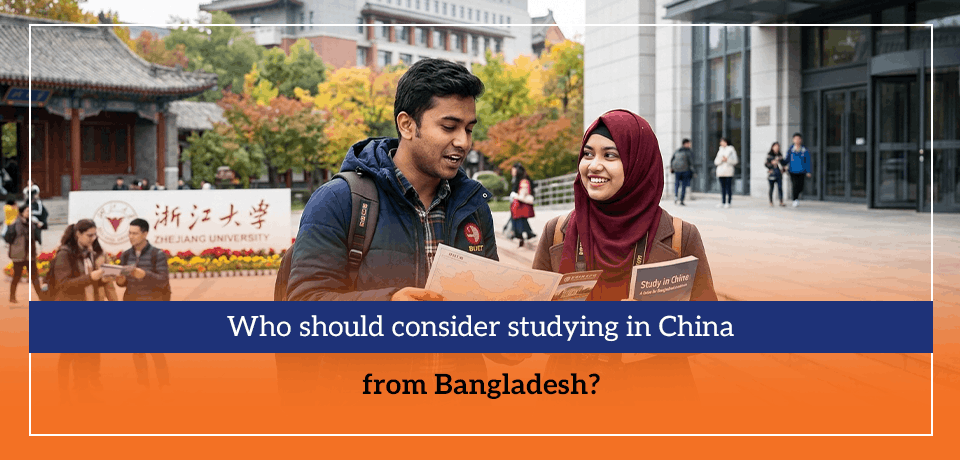
Who should consider studying in China from Bangladesh
China may suit you particularly well if you fall into one of these groups.
Undergraduate students looking for value
If you want a foreign degree without the very high tuition often seen in Anglophone destinations, China is worth considering. This is especially true for students interested in engineering, computer science, business, economics and related fields.
Postgraduate students seeking scholarships or research exposure
For master’s and PhD applicants, China can be attractive because many universities offer funded or partly funded options, and the Chinese Government Scholarship remains an important route for eligible international applicants, including Bangladeshi students.
Students open to English-taught or bilingual academic settings
Not every programme requires Chinese-language study from the beginning. Many universities offer English-taught options, though students should always verify the teaching language at programme level rather than relying on a broad university claim.
Students considering MBBS or health-related courses
This is a special case. China is often discussed as an MBBS destination in Bangladesh, but the decision demands more scrutiny than many agencies admit. Recognition, teaching language, internship issues and licensing pathways all need to be checked before admission.
When China may not be the best choice
China may be a weaker fit if:
- you need a fully English-speaking academic and daily-life environment
- your future profession depends on strict external licensing rules
- your budget is extremely tight and you have no realistic scholarship path
- you expect campus culture, classroom style and social life to mirror the UK, Australia or North America
This does not mean China is unsuitable. It means expectations should be realistic. The strongest applicants are usually the ones who compare the destination against their actual subject, budget and long-term plan, not just against a ranking table.

Top courses to study in China for Bangladeshi students
The most common areas of interest include:
- engineering
- computer science and IT
- business and management
- economics and finance
- pharmacy and selected health sciences
- MBBS and clinical medicine, with careful recognition checks
- Chinese language and international studies
The obvious pattern is that China tends to appeal most where students want a technical or career-oriented degree and a lower cost than many Western options.
Top universities in China for Bangladeshi students
Students often begin with famous names, but brand alone is not the best filter. The better approach is to shortlist universities based on subject strength, teaching language, budget, and city.
Well-known universities for international students include Tsinghua University, Peking University, Fudan University, Shanghai Jiao Tong University, and Zhejiang University. These names carry strong academic reputations, but they are not automatically the best fit for every Bangladeshi applicant. A lower-profile university with a suitable programme, realistic entry criteria and better scholarship access may be the smarter choice.
When shortlisting, focus on these questions instead:
- Is your subject offered in the language you need?
- Are the entry requirements realistic for your profile?
- Is the city affordable for your family?
- Does the scholarship cover only tuition, or also accommodation and a stipend?
- In regulated subjects, is the degree likely to be recognised where you plan to work?
A prestigious university can still be the wrong decision if it creates a budget problem or offers weak support for international students in your subject area.
Best cities in China for Bangladeshi students
City choice shapes your experience almost as much as university choice.
Beijing
Beijing offers major universities, strong academic networks and broad international exposure. It is also one of the more expensive choices. Students who choose Beijing usually do so for reputation and opportunity, not because it is cheap.
Shanghai
Shanghai is another top academic and international hub. It suits students who want a globally connected city, but the cost of living is usually on the higher side.
Mid-cost student cities
Cities such as Nanjing, Wuhan, Chengdu, Hangzhou and others may offer a better balance between cost and quality. They tend to be less overwhelming financially while still hosting strong universities and large student populations.
How to choose your city
A simple rule helps: if your budget is limited, do not choose a city only because it is famous. A lower-cost city with a good university can be a far better study destination than a prestigious city that drains your finances in the first year.
Study in China requirements from Bangladesh
Requirements vary by university and course, but most Bangladeshi students will need to show the following.
Basic academic requirements
- academic transcripts and certificates
- a valid passport
- language test results where required
- a study plan or personal statement
- recommendation letters for many postgraduate programmes
Language requirements
Some programmes ask for IELTS or TOEFL for English-taught study. Others may accept alternative proof, such as a Medium of Instruction certificate, depending on the university. Chinese-taught programmes may require HSK or another accepted proof of Chinese proficiency.
Document attestation
For Bangladeshi students, document preparation can be more time-consuming than expected. Academic records may need notarisation, authentication by the relevant education authority, and further attestation for international use. If your documents are in Bangla, certified translation may also be required before the attestation process is completed.
This is one of those unglamorous details that delays strong applications. Many students focus on scholarships first and paperwork later. In reality, the paperwork often decides whether a promising application reaches the deadline properly.
Can Bangladeshi students study in China without IELTS?
Sometimes, yes. Some Chinese universities may accept other forms of English proficiency evidence for English-taught programmes, such as a Medium of Instruction certificate. Others still prefer or require IELTS or TOEFL.
The useful answer is not simply “yes” or “no”. It is this: check programme-specific requirements. University-wide statements are often too vague to rely on. If a course page does not clearly state what is accepted, treat that as a warning sign and confirm directly before applying.
Tuition fees in China for Bangladeshi students
Tuition in China varies widely by subject, university and degree level. Broadly, many international programmes sit somewhere between lower-cost and mid-range compared with Western destinations, but the range is still large. Independent fee guides for international students commonly place many undergraduate and master’s programmes in roughly the RMB 20,000 to 60,000 per year range, with medicine and some specialised courses often sitting toward the higher end.
A more useful way to think about fees is by category:
- Chinese language or humanities programmes: often at the lower end of the range
- Business, engineering and computing: usually mid-range, depending on university and city
- Medicine and specialised professional programmes: often higher than general academic courses
The real mistake is to focus on tuition alone. Families should estimate total annual cost, not just the university invoice. That is especially important when planning how to fund overseas study.
Living cost in China: approximate RMB and BDT estimates
Living expenses depend heavily on city and lifestyle. Students in Beijing or Shanghai will generally spend more than those in lower-cost student cities. Accommodation type changes the picture sharply too. University dormitories are usually cheaper than private housing, though comfort and availability vary.
As a rough guide, many students budget around RMB 3,000 to 5,000 per month for everyday living costs, excluding tuition. Using an exchange rate of roughly 1 RMB = Tk 17.7 based on recent 2026 averages, that works out to about Tk 53,000 to Tk 88,500 per month.
Here is a practical estimate for planning:
- Monthly living cost: RMB 3,000 to 5,000
Approx. in BDT: Tk 53,000 to Tk 88,500
- Annual living cost: RMB 36,000 to 60,000
Approx. in BDT: Tk 6.37 lakh to Tk 10.62 lakh
- Annual tuition for many international programmes: RMB 20,000 to 60,000
Approx. in BDT: Tk 3.54 lakh to Tk 10.62 lakh
That means a typical self-funded student might need a broad total yearly budget of around RMB 56,000 to 120,000, or roughly Tk 9.9 lakh to Tk 21.2 lakh, before adding flights, accommodation deposits, medical checks, insurance and first-arrival costs. Medicine can be higher. Big-city living can be higher. Funding opportunities and scholarship support can reduce overall costs significantly.
Students should also keep a separate buffer for:
- flight tickets
- required documentation and administrative costs
- medical checks and insurance
- accommodation deposits
- the first few weeks of living expenses before any scholarship support begins
Currency rates move, sometimes quietly, so BDT figures should be treated as planning estimates rather than fixed amounts.
Scholarships for Bangladeshi students in China
Scholarship access is one of the main reasons students consider China in the first place, especially when comparing different China scholarship options.
Chinese Government Scholarship
The Chinese Government Scholarship (CSC) remains one of the best-known routes and may include tuition, accommodation, medical insurance and a monthly stipend, depending on the scholarship type and level of study. The Chinese Embassy in Bangladesh has published official guidance for Bangladeshi applicants, including deadlines and application instructions.
University scholarships
Many Chinese universities offer their own scholarships. These may be full or partial and often depend on academic performance, programme type or international recruitment priorities.
Provincial and municipal scholarships
Some provinces and cities also support international students through local scholarship schemes. These can be useful, but they vary by institution and location.
What to check before accepting a scholarship
Do not stop at the phrase “full scholarship”. Check:
- whether tuition is fully waived
- whether accommodation is included
- whether a monthly stipend is provided
- whether medical insurance is covered
- whether the scholarship is renewable each year and under what conditions
This is where families can misread an offer. A scholarship may sound generous and still leave a significant monthly shortfall.
Intakes and the best time to apply
Most Chinese universities have two main intakes for international students:
- Autumn intake: This is the main intake, with classes usually starting in August or September
- Spring intake: a smaller intake, with classes usually starting in February or March
For most Bangladeshi students, the autumn intake is the better option because it usually offers more courses, more universities, and more scholarship opportunities. The spring intake can still work well, but course choices are often more limited.
A practical timeline is:
- For autumn intake: start preparing from October to January
- For spring intake: start preparing from July to October of the previous year
This gives enough time to shortlist universities, prepare documents, complete attestation and translation, and apply for scholarships, which often close earlier than regular admission deadlines.
In simple terms, if you want the widest choice and better scholarship chances, aim for the autumn intake and start early.

How to apply to universities in China from Bangladesh
Most students apply through university admission portals, scholarship systems, or both, depending on their chosen programme and institution.
Step 1: Shortlist the right programmes
Start with course fit, not university fame. Check:
- subject relevance
- teaching language
- intake period
- tuition fees
- funding & scholarship options
- entry requirements
Step 2: Prepare your documents carefully
Common documents include:
- passport copy
- academic transcripts and certificates
- language proof
- study plan or statement of purpose
- recommendation letters for many postgraduate applications
Step 3: Submit university and scholarship applications separately if needed
In many cases, the university application and scholarship application are not the same process. Missing this detail is more common than it should be.
Step 4: Review your admission offer properly
Once admitted, confirm:
- your course details
- scholarship terms
- tuition payment requirements
- accommodation steps
- official documents provided by the institution
An admission offer is an important milestone in your study journey. It is the point where you move forward with the next official steps based on guidance from your university and relevant authorities.
Preparing to study in China from Bangladesh
After receiving an admission offer, students should carefully prepare for their study journey and ensure all academic requirements are completed properly.
Common documents for studying in China
Students typically need:
- a valid passport
- the admission notice from the university
- academic certificates, transcripts and supporting documents
- relevant university-issued study documents, such as JW201 or JW202, where required
- medical records if requested by the institution, including medical paperwork for studying abroad where applicable
Pre-departure planning students often leave too late
Before travelling, students should prepare:
- accommodation arrangements
- copies of academic and university documents
- health insurance arrangements
- Funding & Scholarship information for managing study-related expenses
Students who rely on outdated information or unofficial advice can face avoidable challenges. The safest approach is to confirm academic requirements, university instructions, and study-related information through official university sources rather than depending on recycled online advice.
MBBS in China for Bangladeshi students: what to verify first
This is where caution matters most.
MBBS in China can be an option for Bangladeshi students, but it should never be approached casually. The Bangladesh Medical & Dental Council (BM&DC) is the authority students should check for recognition-related matters before enrolling in a medical programme abroad. Recognition, teaching language, internship structure and later licensing implications all need to be clarified before admission, not after it.
Before choosing an MBBS programme in China, check:
- whether the university is acceptable for future recognition purposes
- whether the programme language meets current expectations
- what internship arrangements apply
- what licensing or registration implications may follow after graduation
This is the uncomfortable truth in medical education abroad, a low tuition fee does not make a degree low-risk. If recognition fails, the apparent savings can become irrelevant.
Recognition and career value of a Chinese degree in Bangladesh
For many subjects, the value of a Chinese degree depends on the institution, the course, and what you want to do afterwards. In Bangladesh, students may need to go through the foreign degree equivalence process where relevant. For regulated professions, this question is not secondary. It is central.
In practical terms, students should think about recognition before enrolment if they are entering:
- medicine
- dentistry
- pharmacy
- law
- teaching or other regulated professions
For non-regulated fields such as business, economics or many technology disciplines, employer expectations and actual skills may matter more than formal licensing. Even then, institution quality and language ability can shape outcomes significantly.
Can Bangladeshi students work in China while studying?
Students often ask this early, usually with good reason. Cost pressure tends to bring the question forward.
The sensible answer is to check the current rules of your university and the relevant authorities before assuming part-time work is straightforward. Student work rules can involve permission requirements and may not function the way they do in countries with clearer mainstream student work systems. Because of that, families should avoid building a study budget around assumed part-time earnings unless the rules are fully confirmed.

Frequently asked questions
How much does it cost to study in China from Bangladesh?
A broad self-funded estimate for many students is around RMB 56,000 to 120,000 per year, which is roughly Tk 9.9 lakh to Tk 21.2 lakh, depending on tuition, city and lifestyle. Medicine and top-tier city living can push the cost higher.
Is China a good option for Bangladeshi students?
It can be, especially for students looking for a lower-cost overseas degree, scholarship opportunities and strong options in engineering, business, computing and selected health-related fields.
Can I study in China from Bangladesh without IELTS?
Sometimes. Some universities may accept alternative English proficiency evidence, but others still require IELTS or TOEFL. Always confirm the requirement at programme level.
What scholarships are available for Bangladeshi students in China?
The main routes include the Chinese Government Scholarship, university scholarships and some provincial or municipal scholarships. Financial support can vary, so it's wise for students to carefully examine the details before committing to any agreements.
Is MBBS in China from Bangladesh a good choice?
It can be an option, but only if you verify recognition, teaching language, internship issues and licensing implications before admission. This is not a field where assumptions are safe.
How long does the application process take?
It varies by intake, scholarship deadlines, university processing times, and how quickly your documents are prepared. Students who begin early usually have more time to complete requirements and avoid common delays.
Final thoughts on studying in China from Bangladesh
Study in China from Bangladesh can be a practical option for students looking for affordable overseas education opportunities, access to Funding & Scholarship options, and a wide range of courses at recognised universities. However, choosing China should be based on careful evaluation of the course, university, budget, city, and future recognition requirements rather than popularity alone.
The strongest applications usually come from students who make informed decisions early. They choose programmes based on academic and career goals, prepare realistic budgets, review scholarship terms carefully, and confirm university requirements before applying. A thoughtful approach helps students avoid common challenges and build a stronger pathway towards successful international education.