Germany remains one of the most attractive study destinations in Europe for one reason above all: it offers strong public universities, respected degrees and, in many cases, far lower study costs than students expect. That does not mean every public university in Germany is completely free, nor does it mean every institution suits every applicant. Costs vary by state, language of instruction varies by programme, and the right choice depends heavily on what you want to study. Still, if you are looking for a list of public universities in Germany, a realistic sense of tuition fees, and a shortlist of strong options for international students, this is the place to start.
Germany’s higher education system is also broader than many quick rankings suggest. It includes classic research universities, technical universities and universities of applied sciences. That distinction matters. A student aiming for a research-heavy master’s in physics, a practical engineering degree, or an English-taught MBA will not evaluate institutions in quite the same way. The strongest article on public universities in Germany, then, is not just a ranking. It is a useful guide to cost, admission, scholarships and fit.
Overview of public universities in Germany
Germany has more than 400 higher education institutions overall, and public institutions make up the majority. Depending on how institutions are classified, the number of public higher education institutions is often reported at just over 300, which is why search results commonly mention figures such as 313 public universities or public institutions. That number includes different types of institutions, not only traditional research universities.
The phrase public universities in Germany usually leads students to three connected questions. First, which universities are the best? Second, are public universities in Germany tuition-free? Third, which of them are best for international students, English-taught programmes, computer science, master’s study or MBA-related pathways? Those are sensible questions, but they work best when handled with a little nuance rather than with a generic top-10 list alone.
Are public universities in Germany free?
In many cases, yes. In every case, not quite.
Most public universities in Germany do not charge standard tuition fees in the way students may be used to elsewhere. Instead, students usually pay a semester contribution. That contribution often covers administration, student services and, in some cities, transport. In practical terms, this is why Germany is often described as offering tuition-free universities or low-cost public universities.
There are, however, two important caveats. Baden-Württemberg charges many non-EU students tuition of EUR 1,500 per semester at public universities in the state, and TUM now charges tuition for many newly enrolled non-EEA students depending on the programme. So the safest wording is this: many public universities in Germany are tuition-free or low-cost, but the actual fee depends on the university, the federal state, the programme and the student’s nationality.
Criteria for ranking
Universities can be ranked in countless ways, but for students comparing public universities in Germany, a few factors matter more than the rest.
Academic strength
This includes research reputation, faculty depth, graduate outcomes and subject-specific standing. A university may be excellent overall but especially strong in engineering, medicine, economics or humanities.
International relevance
Some universities are easier for international students to navigate. They may offer more English-taught programmes, stronger support structures or wider global recognition.
Cost and value
Low tuition is not the whole story. Living costs, especially in Munich and Berlin, can shift the real affordability of a university quite dramatically.
Subject fit
The best public university in Germany for computer science is not necessarily the best one for law, history or international relations.
Career and research opportunities
Industry links, doctoral pathways, entrepreneurship ecosystems and the wider city matter more than many students first realise.
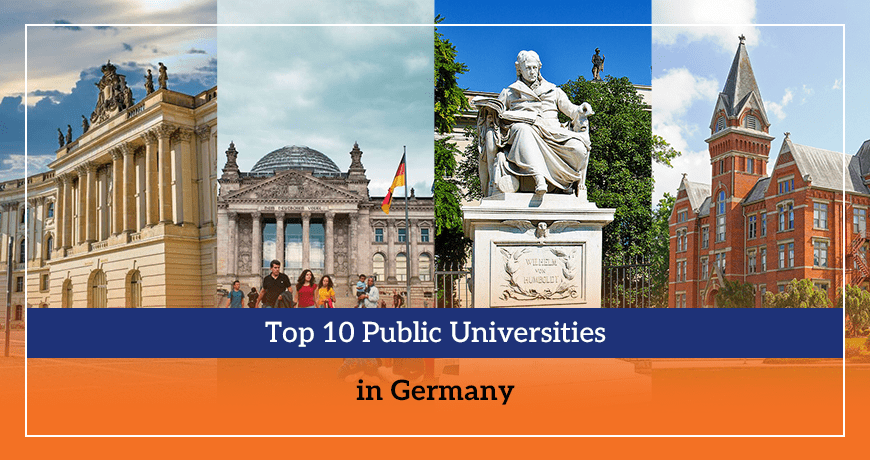
Top 10 public universities in Germany
1. Technical University of Munich (TUM)
Right in the heart of Munich, TUM stands out as one of the best public universities in Germany and is widely recognised as one of the country’s leading research universities. Known for its innovation, international visibility and academic strength, TUM attracts students from around the world for engineering, computer science, management, life sciences and technology-driven interdisciplinary programmes.
It is also one of the first names students encounter when searching for the top 10 public universities in Germany, public universities in Germany for computer science, or the best public university in Germany for international students. Munich adds obvious appeal: it is a major technology and business hub with strong career prospects, though the city’s housing costs are high. TUM also now charges tuition for many newly enrolled non-EEA students, so applicants should check the programme-level fee structure carefully rather than assume it is fully tuition-free.
Key Departments:
- Aerospace Engineering
- Mechanical Engineering
- Computer Science
- Management and Technology
- Life Sciences
Notable Features:
- Strong industry connections
- Top-ranked engineering programmes
- Excellent start-up and innovation culture
- Vibrant student life in Munich
Overall Details:
Tuition Fee: Approx. semester contribution for many students; additional tuition may apply for many newly enrolled non-EEA students depending on programme
- Undergraduate Duration: 3-4 years
- Postgraduate Duration: 2 years
- Established: 1868
- Total Programmes: 177
- Total Students: 51,954
- Total Faculty: 698 professors
- Location: Arcisstraße 21, 80333 Munich, Germany
Scholarship and Admission Notes:
TUM offers scholarships and waivers in selected cases, and DAAD funding may also be relevant. Admission is programme-specific and often competitive, especially in engineering, management and informatics. English-taught options are strongest at master’s level.
2. Ludwig Maximilian University Munich (LMU Munich)
Studying at LMU is like stepping into a university where history and modern research genuinely meet. Founded in 1472, LMU is one of the oldest universities in Germany and one of its most respected comprehensive institutions. Located in Munich, it is especially strong in medicine, biosciences, natural sciences, economics and the humanities. It is a frequent inclusion in any serious list of public universities in Germany for international students because it combines prestige with broad academic choice. The university has a strong research identity and a highly international environment, though its real-world affordability is shaped as much by Munich rents as by university fees.
Key Departments:
- Medicine
- Data Science
- Economics
- Physics
- Biology and Biosciences
Notable Features:
- Historic campus and academic reputation
- Strong research culture
- Broad subject range
- Good international visibility
Overall Details:
- Tuition Fee: Approx. EUR 97 semester contribution for summer semester 2026; no standard tuition for most students
- Undergraduate Duration: 3-4 years
- Postgraduate Duration: 2 years
- Established: 1472Total Programmes: Approx. 300+ across faculties and degree routes
- Total Students: 52,658
- Total Faculty: 840 professors
- Location: Geschwister-Scholl-Platz 1, 80539 Munich, Germany
Scholarship and Admission Notes:
LMU students commonly rely on DAAD, Deutschlandstipendium and faculty-level funding. Admission varies sharply by subject; medicine and some restricted-entry programmes are significantly more competitive than others. English-taught programmes are more common at master’s level.
3. Heidelberg University
Heidelberg University is all about academic quality in a city that feels unmistakably like a university town. Founded in 1386, it is the oldest university in Germany and remains one of the country’s strongest public universities for medicine, life sciences, natural sciences, law and the humanities. Heidelberg is often one of the first institutions named in searches for the best public universities in Germany, and with good reason: it combines reputation, research depth and a globally recognisable academic brand. The point to watch is cost for many non-EU students, since Baden-Württemberg applies state-level tuition in addition to the semester contribution.
Key Departments:
- Medicine
- Natural Sciences
- Life Sciences
- Law
- Humanities
Notable Features:
- Oldest university in Germany
- Strong emphasis on research
- International academic reputation
- Historic student city atmosphere
Overall Details:
- Tuition Fee: Approx. EUR 161.10 semester contribution; around EUR 1,500 per semester may apply to many non-EU students under Baden-Württemberg rules
- Undergraduate Duration: 3-4 years
- Postgraduate Duration: 2 years
- Established: 1386
- Total Programmes: 192
- Total Students: 32,178
- Total Faculty: 562 professorships
- Location: Grabengasse 1, 69117 Heidelberg, Germany
Scholarship and Admission Notes:
DAAD, research-linked grants and faculty funding are important routes here. Admission is programme-specific, with medicine and other high-demand courses notably competitive. English-taught options exist, especially at postgraduate level, but many routes still require German.
4. RWTH Aachen University
RWTH Aachen University is one of the strongest choices in Germany for students who want engineering, manufacturing, applied sciences and serious technical training. It is the kind of university that tends to appear in almost every credible list of public universities in Germany for engineering, computer science and international students, alongside other leading engineering universities in Germany.
Aachen itself is an advantage: it is smaller and generally more manageable than Munich, but still highly international, partly because of its location near Belgium and the Netherlands. Unlike TUM, RWTH states that it does not charge additional tuition for international students from non-EU countries beyond the normal semester fee.
Key Departments:
- Mechanical Engineering
- Electrical Engineering
- Computer Science
- Civil Engineering
- Materials Engineering
Notable Features:
- Largest and best-known technical university networks in Germany
- Strong practical and industrial focus
- High reputation in engineering
- International border-region location
Overall Details:
- Tuition Fee: Approx. semester contribution only; no additional tuition for non-EU students in the standard model
- Undergraduate Duration: 3-4 years
- Postgraduate Duration: 2 years
- Established: 1870
- Total Programmes: 178 courses of study (including some privately offered courses)
- Total Students: 44,892
- Total Faculty: 569 professors
- Location: Templergraben 55, 52062 Aachen, Germany
Scholarship and Admission Notes:
DAAD and external scholarships are often more relevant than automatic university awards. Admission is programme-led, and while entry may appear more accessible than students expect, academic standards after enrolment are demanding. RWTH offers a good spread of English-taught master’s options.
5. Humboldt University of Berlin
Humboldt University of Berlin remains one of the defining names in European higher education. Founded in 1810, it is especially well known for humanities, philosophy, history, economics, law and selected science fields. It is not a technical university in the TUM or RWTH mould; rather, it is a classic research university with intellectual depth and a central Berlin location. That combination makes it particularly attractive to students interested in the social sciences, public policy, political thought and internationally recognisable academic traditions.
Key Departments:
- History
- Philosophy
- Economics
- Law
- Natural Sciences
Notable Features:
- Historic role in shaping the research university model
- Strong humanities and social sciences profile
- Prime location in Berlin
- International research partnerships
Overall Details:
- Tuition Fee: Approx. semester contribution; no standard tuition in the general public model
- Undergraduate Duration: 3-4 years
- Postgraduate Duration: 2 years
- Established: 1810
- Total Programmes: Approx. 170+
- Total Students: Approx. 37,000+
- Total Faculty: 509 professorships
- Location: Unter den Linden 6, 10099 Berlin, Germany
Scholarship and Admission Notes:
DAAD, Deutschlandstipendium and research-linked funding are common funding routes. Competition depends heavily on the programme rather than the institution as a whole. Berlin also gives the university an edge for internships, networks and cultural life.
6. Freie Universität Berlin
Freie Universität Berlin is another major public university in Germany, particularly strong in humanities, social sciences, politics, area studies and life sciences. Founded in 1948, it has a distinct identity shaped by academic freedom, international collaboration and research breadth. It is frequently shortlisted by students looking for public universities in Germany with English-taught programmes, or public universities in Germany for international students, because Berlin itself remains such a strong draw.
Key Departments:
- Political Science
- International Relations
- Biology
- Business and Economics
- Area Studies
Notable Features:
- Strong focus on academic freedom
- Global reputation in arts, humanities and social sciences
- Large international network
- Modern research environment in Berlin
Overall Details:
- Tuition Fee: Approx. semester contribution; no standard tuition in the general public model
- Undergraduate Duration: 3-4 years
- Postgraduate Duration: 2 years
- Established: 1948
- Total Programmes: Approx. 150+
- Total Students: Approx. 33,500
- Total Faculty: About 460 professors
- Location: Kaiserswerther Str. 16-18, 14195 Berlin, Germany
Scholarship and Admission Notes:
DAAD, Deutschlandstipendium and programme-level support are common funding options. Admission standards vary by programme, and English-taught master’s courses often attract strong international demand.
7. Karlsruhe Institute of Technology (KIT)
KIT is the place many students turn to when they want a serious technical university without defaulting automatically to Munich or Aachen. It is especially strong in engineering, computer science, mathematics, natural sciences and applied research. KIT combines a technical university profile with the scale of a major research institution, which is one reason it appears frequently in searches for public universities in Germany for computer science and engineering. The catch, again, is Baden-Württemberg’s tuition policy for many non-EU students.
Key Departments:
- Mechanical Engineering
- Computer Science
- Electrical Engineering
- Physics
- Environmental Engineering
Notable Features:
- Strong STEM focus
- Research-intensive technical environment
- Clear fit for engineering and computing
- Close ties between research and industry
Overall Details:
- Tuition Fee: Approx. standard semester contribution for many students; around EUR 1,500 per semester may apply to many non-EU students under Baden-Württemberg rules
- Undergraduate Duration: 3-4 years
- Postgraduate Duration: 2 years
- Established: 1825 roots; KIT established in its current form in 2009
- Total Programmes: 112 degree programmes
- Total Students: 23,083
- Total Faculty: 424 professors
- Location: Kaiserstraße 12, 76131 Karlsruhe, Germany
Scholarship and Admission Notes:
DAAD and external scholarships are especially relevant. English-taught options are stronger at master’s level. KIT is a strong choice for technically focused students who care more about subject fit than city prestige.
8. TU Berlin
TU Berlin is one of the most appealing public universities in Germany for students who want engineering, architecture, urban systems or computer science in a major capital city. The university benefits from Berlin’s labour market, start-up culture and international student population. It is one of those institutions that performs especially well in searches related to public universities in Germany with English-taught programmes and public universities in Germany for master’s study, largely because Berlin is often the first city many applicants consider.
Key Departments:
- Computer Science
- Electrical Engineering
- Mechanical Engineering
- Architecture
- Urban Planning
Notable Features:
- Strong technical and design-oriented programmes
- Central location in Berlin
- Large international student community
- Good access to internships and networks
Overall Details:
- Tuition Fee: Approx. semester contribution; no standard tuition in the general public model
- Undergraduate Duration: 3-4 years
- Postgraduate Duration: 2 years
- Established: 1879
- Total Programmes: Approx. 100+
- Total Students: 33,990
- Total Faculty: Approx. 350+ professors
- Location: Straße des 17. Juni 135, 10623 Berlin, Germany
Scholarship and Admission Notes:
DAAD, Deutschlandstipendium and merit-based external funding are common routes. Admission competition tends to be strongest in high-demand technical master’s courses. English-taught options are more common at postgraduate level than at bachelor’s level.
9. TU Dresden
TU Dresden offers a mix that many international students quietly prefer: strong engineering and science credentials, a respected research profile, and a city that is usually easier on the budget than Munich or Berlin. It is one of Germany’s Universities of Excellence and offers a notable number of English-taught and double-degree options. For students comparing public universities in Germany for master’s study, engineering or computer science, TU Dresden deserves to be taken more seriously than it often is in generic rankings.
Key Departments:
- Mechanical Engineering
- Civil Engineering
- Computer Science
- Medicine
- Natural Sciences
Notable Features:
- University of Excellence status
- Strong engineering and science profile
- More affordable city than Munich
- Good range of English-taught and double-degree options
Overall Details:
- Tuition Fee: Approx. semester contribution; no standard tuition in the general public model
- Undergraduate Duration: 3-4 years
- Postgraduate Duration: 2 years
- Established: 1828
- Total Programmes: 119
- Total Students: Around 29,000
- Total Faculty: Around 600 professors
- Location: Mommsenstraße 9, 01069 Dresden, Germany
Scholarship and Admission Notes:
DAAD and university-linked support may be relevant depending on degree level and applicant profile. International students should check programme requirements carefully, especially for language and qualification recognition.
10. University of Bonn
The University of Bonn now belongs firmly in the top-tier discussion of public universities in Germany. It has a particularly strong reputation in mathematics, economics, natural sciences, agricultural sciences and the humanities, and its profile has grown through the Excellence Strategy. Bonn is a good reminder that the best public university list in Germany should not stop at Munich and Berlin. For many students, especially those interested in research-led master’s degrees, Bonn is one of the strongest alternatives.
Key Departments:
- Mathematics
- Economics
- Agricultural Sciences
- Physics
- Humanities
Notable Features:
- University of Excellence profile
- Strong reputation in mathematics and economics
- Research-intensive environment
- Balanced city-cost profile compared with Munich
Overall Details:
- Tuition Fee: Approx. semester contribution; no standard tuition in the general public model
- Undergraduate Duration: 3-4 years
- Postgraduate Duration: 2 years
- Established: 1818
- Total Programmes: Over 200
- Total Students: About 31,500
- Total Faculty: Approx. 700+ professors
- Location: Regina-Pacis-Weg 3, 53113 Bonn, Germany
Scholarship and Admission Notes:
DAAD and external funding are important for international applicants. Application routes vary by programme and may involve direct application or uni-assist. Bonn is particularly attractive for students seeking strong public universities in Germany for master’s, economics and mathematically intensive fields.
List of public universities in Germany: top 50 comparison table
The table below is designed to be more useful than a bare ranking. It keeps the focus on the factors students actually compare: city, type, typical fee reality, English-taught potential, admission route and funding context.
|
Rank
|
University
|
City
|
Type
|
Typical Fee Reality
|
English-Taught Potential
|
Admission Route
|
Scholarship/Funding Snapshot
|
|
1
|
Technical University of Munich (TUM)
|
Munich
|
Technical university
|
Semester contribution; additional tuition for many newly enrolled non-EEA students
|
Strong, especially for master’s
|
Programme-specific
|
TUM support, waivers, DAAD
|
|
2
|
LMU Munich
|
Munich
|
Research university
|
Low semester contribution
|
Good, especially postgraduate
|
Programme-specific
|
DAAD, Deutschlandstipendium
|
|
3
|
Heidelberg University
|
Heidelberg
|
Research university
|
Semester contribution; Baden-Württemberg fees may apply to many non-EU students
|
Good postgraduate options
|
Programme-specific
|
DAAD, faculty funding
|
|
4
|
RWTH Aachen University
|
Aachen
|
Technical university
|
Semester contribution only in standard model
|
Strong in technical master’s
|
Programme-specific
|
DAAD, external funding
|
|
5
|
Humboldt University of Berlin
|
Berlin
|
Research university
|
Semester contribution
|
Selected English options
|
Programme-specific
|
DAAD, research funding
|
|
6
|
Freie Universität Berlin
|
Berlin
|
Research university
|
Semester contribution
|
Good international options
|
Programme-specific
|
DAAD, Deutschlandstipendium
|
|
7
|
KIT
|
Karlsruhe
|
Technical university
|
Semester contribution; Baden-Württemberg fees may apply
|
Strong STEM master’s options
|
Programme-specific
|
DAAD, possible exemptions
|
|
8
|
TU Berlin
|
Berlin
|
Technical university
|
Semester contribution
|
Good postgraduate options
|
Programme-specific
|
DAAD, merit-based support
|
|
9
|
TU Dresden
|
Dresden
|
Technical university
|
Semester contribution
|
Good and growing
|
Programme-specific
|
DAAD, university-linked support
|
|
10
|
University of Bonn
|
Bonn
|
Research university
|
Semester contribution
|
Selected English programmes
|
Programme-specific
|
DAAD, external funding
|
|
11
|
University of Freiburg
|
Freiburg
|
Research university
|
Semester contribution; Baden-Württemberg fees may apply
|
Good postgraduate options
|
Programme-specific
|
DAAD, faculty support
|
|
12
|
University of Tübingen
|
Tübingen
|
Research university
|
Semester contribution; Baden-Württemberg fees may apply
|
Good research-led options
|
Programme-specific
|
DAAD, research funding
|
|
13
|
University of Mannheim
|
Mannheim
|
Research university
|
Semester contribution; Baden-Württemberg fees may apply
|
Strong in business and economics
|
Programme-specific
|
DAAD, merit support
|
|
14
|
University of Stuttgart
|
Stuttgart
|
Technical university
|
Semester contribution; Baden-Württemberg fees may apply
|
Good technical master’s options
|
Programme-specific
|
DAAD, external support
|
|
15
|
University of Cologne
|
Cologne
|
Research university
|
Semester contribution
|
Selected English options
|
Programme-specific
|
DAAD, Deutschlandstipendium
|
|
16
|
University of Hamburg
|
Hamburg
|
Research university
|
Semester contribution
|
Growing selection
|
Programme-specific
|
DAAD, city-linked support
|
|
17
|
Leipzig University
|
Leipzig
|
Research university
|
Semester contribution
|
Some English options
|
Programme-specific
|
DAAD, merit funding
|
|
18
|
University of Göttingen
|
Göttingen
|
Research university
|
Semester contribution
|
Strong research postgraduate options
|
Programme-specific
|
DAAD, research funding
|
|
19
|
University of Würzburg
|
Würzburg
|
Research university
|
Semester contribution
|
Selected English options
|
Programme-specific
|
DAAD, faculty funding
|
|
20
|
University of Münster
|
Münster
|
Research university
|
Semester contribution
|
Selected English options
|
Programme-specific
|
DAAD, merit support
|
|
21
|
University of Bremen
|
Bremen
|
Research university
|
Semester contribution
|
Some English programmes
|
Programme-specific
|
DAAD, research support
|
|
22
|
University of Potsdam
|
Potsdam
|
Research university
|
Semester contribution
|
Good Berlin-area appeal
|
Programme-specific
|
DAAD, merit support
|
|
23
|
Johannes Gutenberg University Mainz
|
Mainz
|
Research university
|
Semester contribution
|
Selected English options
|
Programme-specific
|
DAAD, external funding
|
|
24
|
Goethe University Frankfurt
|
Frankfurt
|
Research university
|
Semester contribution
|
Strong in master’s study
|
Programme-specific
|
DAAD, external scholarships
|
|
25
|
University of Jena
|
Jena
|
Research university
|
Semester contribution
|
Some English options
|
Programme-specific
|
DAAD, research support
|
|
26
|
Saarland University
|
Saarbrücken
|
Research university
|
Semester contribution
|
Strong in computer science and linguistics
|
Programme-specific
|
DAAD, institute-linked support
|
|
27
|
University of Konstanz
|
Konstanz
|
Research university
|
Semester contribution; Baden-Württemberg fees may apply
|
Selected English programmes
|
Programme-specific
|
DAAD, merit-based options
|
|
28
|
University of Bayreuth
|
Bayreuth
|
Research university
|
Semester contribution
|
Some English options
|
Programme-specific
|
DAAD, programme funding
|
|
29
|
Leibniz University Hannover
|
Hannover
|
Research university
|
Semester contribution
|
Good technical master’s options
|
Programme-specific
|
DAAD, external support
|
|
30
|
Kiel University
|
Kiel
|
Research university
|
Semester contribution
|
Some English options
|
Programme-specific
|
DAAD, research funding
|
|
31
|
University of Duisburg-Essen
|
Duisburg/Essen
|
Research university
|
Semester contribution
|
Selected English options
|
Programme-specific
|
DAAD, inclusion-focused support
|
|
32
|
Chemnitz University of Technology
|
Chemnitz
|
Technical university
|
Semester contribution
|
Some English master’s options
|
Programme-specific
|
DAAD, technical funding
|
|
33
|
Otto von Guericke University Magdeburg
|
Magdeburg
|
Research university
|
Semester contribution
|
Some English options
|
Programme-specific
|
DAAD, regional support
|
|
34
|
University of Regensburg
|
Regensburg
|
Research university
|
Semester contribution
|
Selected English options
|
Programme-specific
|
DAAD, merit funding
|
|
35
|
University of Hohenheim
|
Stuttgart
|
Specialised public university
|
Semester contribution; Baden-Württemberg fees may apply
|
Good postgraduate options
|
Programme-specific
|
DAAD, subject funding
|
|
36
|
Bielefeld University
|
Bielefeld
|
Research university
|
Semester contribution
|
Selected English options
|
Programme-specific
|
DAAD, external support
|
|
37
|
University of Erfurt
|
Erfurt
|
Research university
|
Semester contribution
|
Limited but useful options
|
Programme-specific
|
DAAD, foundation funding
|
|
38
|
TU Clausthal
|
Clausthal-Zellerfeld
|
Technical university
|
Semester contribution
|
Selected English technical options
|
Programme-specific
|
DAAD, research-linked support
|
|
39
|
University of Paderborn
|
Paderborn
|
Research university
|
Semester contribution
|
Some English options
|
Programme-specific
|
DAAD, merit support
|
|
40
|
University of Rostock
|
Rostock
|
Research university
|
Semester contribution
|
Selected English options
|
Programme-specific
|
DAAD, regional support
|
|
41
|
Hochschule München University of Applied Sciences
|
Munich
|
University of applied sciences
|
Semester contribution
|
More limited but practical options
|
Programme-specific
|
DAAD, external support
|
|
42
|
HTW Berlin
|
Berlin
|
University of applied sciences
|
Semester contribution
|
Some English-taught options
|
Programme-specific
|
DAAD, merit support
|
|
43
|
Hochschule Darmstadt
|
Darmstadt
|
University of applied sciences
|
Semester contribution
|
Some English options
|
Programme-specific
|
DAAD, applied-study support
|
|
44
|
Frankfurt University of Applied Sciences
|
Frankfurt
|
University of applied sciences
|
Semester contribution
|
Limited but practical options
|
Programme-specific
|
DAAD, local support
|
|
45
|
TH Köln
|
Cologne
|
University of applied sciences
|
Semester contribution
|
Good practical course mix
|
Programme-specific
|
DAAD, project funding
|
|
46
|
Hochschule Bremen
|
Bremen
|
University of applied sciences
|
Semester contribution
|
Useful international orientation
|
Programme-specific
|
DAAD, mobility funding
|
|
47
|
Hochschule Hannover
|
Hannover
|
University of applied sciences
|
Semester contribution
|
Some English options
|
Programme-specific
|
DAAD, practical-study support
|
|
48
|
Hochschule Osnabrück
|
Osnabrück
|
University of applied sciences
|
Semester contribution
|
Selected English programmes
|
Programme-specific
|
DAAD, subject support
|
|
49
|
TH Nürnberg Georg Simon Ohm
|
Nuremberg
|
University of applied sciences
|
Semester contribution
|
Selected English options
|
Programme-specific
|
DAAD, external funding
|
|
50
|
Hochschule Karlsruhe
|
Karlsruhe
|
University of applied sciences
|
Semester contribution; Baden-Württemberg fees may apply
|
Some English options
|
Programme-specific
|
DAAD, possible exemptions
|
Public universities in Germany for international students
International students usually compare public universities in Germany through four practical lenses: language, cost, admission and career value.
Public universities in Germany with English-taught programmes
Germany offers a strong number of English-taught programmes, especially at master’s level. That is why students search for public universities in Germany with English-taught programs or a list of public universities in Germany for master’s. The important reality, though, is that bachelor’s degrees taught fully in English are still much less common than English-taught master’s courses. The safest route is to search by programme, not just by university name.
Public universities in Germany for computer science
For computer science, the names that come up repeatedly are TUM, RWTH Aachen, KIT, TU Berlin, TU Dresden and Saarland University. That does not mean smaller or less famous institutions are weak. It means these universities have strong reputations, technical ecosystems and international visibility in the field.
Public universities in Germany for MBA and business-related study
Are you searching for public universities in Germany for MBA? Look carefully at the distinction between degree types. MBA programmes in Germany may be executive, part-time or tuition-based, even at public universities, so they do not always fit the standard low-cost public model. For economics, management, business analytics and related master’s degrees, institutions such as TUM, LMU, Mannheim, Bonn and Cologne are often more relevant than a narrow MBA-only search would suggest, especially when compared with Germany’s stronger MBA options.
Scholarships for public universities in Germany
The word “tuition-free” can be a little misleading if it makes students forget everything else they need to pay for. Rent, health insurance, food, transport, visa-related financial proof and study materials remain substantial costs. That is where scholarships matter.
DAAD scholarships
DAAD remains one of the most important scholarship routes for international students in Germany. It is especially relevant for postgraduate study, research and certain subject-specific pathways.
Deutschlandstipendium
Many public universities in Germany participate in the Deutschlandstipendium, a merit-based scholarship programme that can support strong students across subject areas.
University-specific funding
Some universities offer emergency grants, fee waivers, completion grants or targeted scholarships. TUM is a notable example because of the link between its non-EEA tuition model and waiver or scholarship mechanisms.
External foundations and subject-specific grants
In Germany, funding often comes through several smaller or more specialised routes rather than one large all-inclusive scholarship. That is especially true at master’s and doctoral level.

Admission requirements for public universities in Germany
Admission is rarely straightforward at university level alone. It is far more accurate to think in terms of programme-specific entry rules.
Qualification recognition
International applicants should check whether their previous qualifications are recognised for direct entry. In some cases, a preparatory route such as Studienkolleg may be required.
uni-assist and direct applications
Some public universities use uni-assist for international applications, while others handle applications directly. It is important not to assume the same route applies everywhere.
Language requirements
The question is not really “Do I need IELTS for Germany?” The better question is “What proof of language proficiency does this programme accept?” English-taught courses may require IELTS, TOEFL or an equivalent. German-taught courses usually require recognised German-language proof. This varies by university and by programme.
Restricted and unrestricted admission
Some programmes admit all qualified candidates. Others are restricted-admission courses where meeting the formal minimum does not guarantee a place. That is why questions such as “What is the easiest public university to get in Germany?” are not especially useful. The more accurate question is which universities offer your subject with realistic entry conditions for your academic record.
Factors to consider when choosing a university
Academic fit
Choose the programme before the prestige label. A brilliant university can still be the wrong fit for your subject.
Financial reality
Public university in Germany often means low tuition, but total cost depends heavily on city and lifestyle. Munich and Berlin are not priced like Dresden, Aachen or Leipzig.
Mode of instruction
Students often overestimate how many undergraduate courses are fully available in English. This is much less of an issue at master’s level.
Career direction
Research universities and universities of applied sciences prepare students differently. If you want practical, job-oriented training, one of the applied science universities in Germany may suit you better than a traditional research institution.
Location and quality of life
A university is also a housing market, a transport system, a social environment and a local job market. Those things shape student life more than brochures tend to admit, especially if you are thinking about staying in Germany after graduation.

Frequently Asked Questions
Is public university free in Germany?
Many public universities in Germany are tuition-free in the standard sense, but semester contributions still apply, and some non-EU students pay tuition in Baden-Württemberg or at universities such as TUM depending on the programme.
Do I need IELTS for Germany?
Only if your course requires it or accepts it as valid proof of English proficiency. The requirement depends on the language of instruction and the programme, not on Germany as a whole.
Which public university is best in Germany?
There is no single answer, but TUM, LMU Munich, Heidelberg University, RWTH Aachen University, Humboldt University of Berlin and Freie Universität Berlin are among the strongest and most visible names.
What is the easiest public university to get in Germany?
That question is too broad to be helpful. Admission depends much more on the programme than the university name. Some courses are highly selective; others are far more accessible if your qualifications match the formal requirements.
Conclusion
Public universities in Germany remain one of the strongest options in Europe for students who want respected degrees, strong academic ecosystems and, in many cases, comparatively low study costs. The important thing is not to treat them as one interchangeable group. TUM is not RWTH Aachen. LMU is not KIT. Heidelberg is not TU Berlin. Some universities are better for research, some for technical training, some for international social-science study, and some for practical, career-oriented education.
If you are comparing public universities in Germany, start with your subject, then check the language of instruction, the likely fee reality, scholarship options, admission route and the cost of living in the city. That approach is slower than relying on a generic ranking, but it usually leads to a far better shortlist.