Anyone trying to check visa status with passport number alone meets the same wall. The passport field exists on most portals, and it is almost never the key that opens the record.
Immigration systems index applications by the number they generated when you applied. Your passport number sits beside that as a confirming detail.
Depending on where you applied, the portal may also want an application number, a reference number or a case number. Some add your date of birth, your surname as written on the form, or a sign-in to the account you applied through.
This guide sets out what each major system actually accepts, and what to do when nothing shows up.
Can You Check Visa Status With a Passport Number?
Sometimes, and rarely on its own. A passport number is one of the details an immigration authority holds against your file, and some systems accept it as part of a lookup. Very few treat it as the single key.
The reason is practical. Passport numbers change when you renew, they repeat across issuing countries, and one applicant can hold records under two documents. The number the authority generated for your visa application has none of those problems, so the portal is built around it.
One official exception is worth knowing before you start. Canada lets you identify a case by passport number and issuing country on its written enquiry form. That is a request answered by staff rather than an instant lookup.
|
Country
|
Is a passport number alone usually enough?
|
Other details commonly required
|
|
USA
|
No
|
Application ID from the DS-160 confirmation page, or case number, plus application location
|
|
UK
|
No
|
GWF or UAN application reference; UKVI account sign-in
|
|
Canada
|
Only on the written enquiry form
|
Application number or UCI, name, date of birth
|
|
Australia
|
No
|
ImmiAccount sign-in, or the TRN for that application
|
|
UAE
|
Depends on the service
|
Application or request number, on the portal for that emirate
|
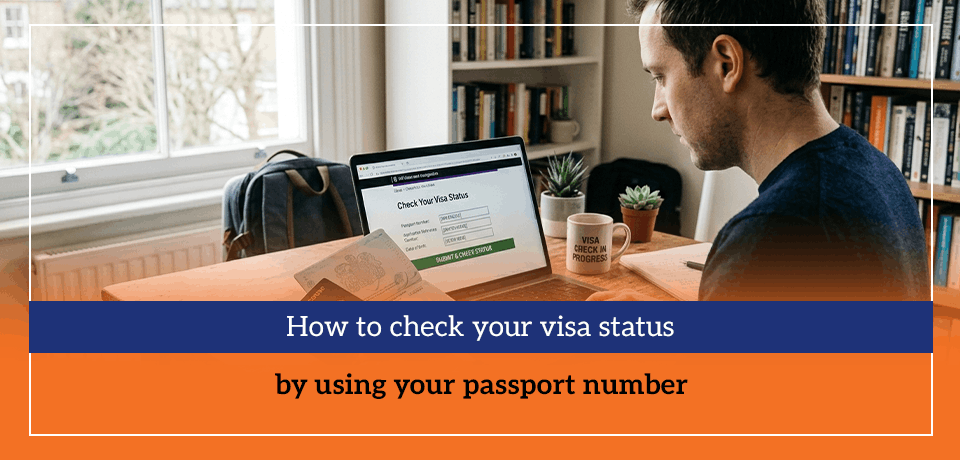
How to check your visa status by using your passport number
The generic process is the same everywhere, and the step people get wrong is the second one rather than the first. Most failed status checks come from using the right details on the wrong portal.
- Visit the official immigration portal for the country that will decide your case. That means the government immigration website or an officially authorised visa service, not a commercial site offering to look your status up for you. The authority that receives the application is the only one holding its status.
- Find the status or tracking service. It may be labelled Check Application Status, Track Application, Visa Status or Application Status. Some countries put it behind an account sign-in rather than a public form, which is itself the answer to whether a passport number will do.
- Enter your passport number. Use the document you actually applied with. If you have renewed your passport since applying, the older number is the one attached to the file, and a renewal is usually something you must report to the authority separately.
- Add your application or reference details. This is where the check succeeds or fails. Depending on the system, you will need an application ID, a case number, a reference number, an acknowledgement number or a tracking number. It is printed on the confirmation or receipt you were sent when you applied.
- Complete identity verification. Expect a date of birth, a surname, sometimes a nationality or email address, and a CAPTCHA. Surnames must match the application rather than your everyday spelling.
- Read the result against that country’s vocabulary. Status wording is not standardised between authorities, and the same word can mean different stages in two systems.
How Visa Status Tracking Works by Country
The UK has no public status lookup at all, and two of the other four systems below put theirs behind an account sign-in. What counts as a status check in one country is a written enquiry in another.
United States
A passport number alone will not open a US visa record. The Department of State’s CEAC status check is keyed to your application ID or case number, together with the location you applied at. The identifier you need therefore comes from the application itself.
For a non-immigrant visa, that identifier is the barcode on your DS-160 confirmation page. It begins with AA and is followed by eight digits. This is the single detail most applicants cannot find later, so it is worth locating before you open the portal. Immigrant visa case numbers run to 14 digits with no letters.
If the confirmation page is gone, your passport will not recover the identifier. The visa application centre or embassy that handled your case is the route back to it. You can run the check on the official CEAC Visa Status Check. For students weighing up universities in the United States, keep that DS-160 page saved somewhere separate from the application account itself.
United Kingdom
There is no public UK portal where you type in a passport number and see a decision. GOV.UK’s own instruction is that you will get a letter or email telling you the Home Office has made a decision on your application. The decision reaches you, rather than you going to find it.
What you monitor instead is your UKVI account where you have one, the email address you applied with, and your GWF number or Unique Application Number. That 16-digit reference appears on Home Office emails and letters. Setting up a UKVI account to reach your eVisa takes a valid passport plus that number, which is the clearest statement anywhere of how the two work together.
Decisions usually take between three and 12 weeks depending on the route, and settlement applications run longer. Before contacting anyone, check the current UK visa processing time, and read the official UK visa decision guidance on how an outcome is sent. This matters most for students preparing for higher education in the UK, where enrolment dates are fixed.
Canada
Canada does not have one status tool. IRCC asks you to select your application type first, because the method depends on what you applied for and how you submitted it.
The application status tracker is the usual route, and registering for it takes your UCI or client ID, your application number, your name, date of birth and place of birth. A passport number is not on that list. Nothing appears there until you have your acknowledgement of receipt, so an empty tracker in the early weeks is normal.
The exception mentioned earlier sits in IRCC’s written enquiry form, which accepts an application number, a UCI, or a passport number with its issuing country as the case identifier. Start by using the correct IRCC application status service for your application type. For international students exploring Canadian education, keep the AOR email, since both numbers you need are in it.
Australia
Australia separates a pending application from a visa already in effect more strictly than most systems, and mixing the two up is the most common mistake here.
For an application still under assessment, the tool is ImmiAccount. Home Affairs states that after you submit your application, you can use ImmiAccount to check messages, check your application status, update details or withdraw your application. The status sits on the My applications summary page. You can check an Australian application through ImmiAccount with the account you applied through, or with the TRN for that application.
VEVO is a different service and does not do this job. Home Affairs states that VEVO tells you details relating to your current in-effect visa. It is not able to provide any details relating to visas that are not in effect. An application still under assessment falls outside what it can answer.
Use VEVO to check current visa details and conditions once a visa has been granted. That distinction is useful for students considering Australian universities who need to confirm work or study conditions before term starts.
UAE
Which authority holds your status depends on the emirate. For Abu Dhabi, Sharjah, Ajman, Umm Al Quwain, Ras Al Khaimah and Fujairah, the UAE Government directs applicants to ICP. Dubai applications are handled by the GDRFA instead.
Checking on the wrong one returns nothing, which reads like a lost application. ICP tracking uses the application number issued when the request was submitted, and those numbers begin with 010. Dubai applicants work from the GDRFA service or the sponsor who lodged the request, since employment and family entry permit applications are usually submitted on the applicant’s behalf. The official UAE visa application and validity checker sets out which service applies to you.
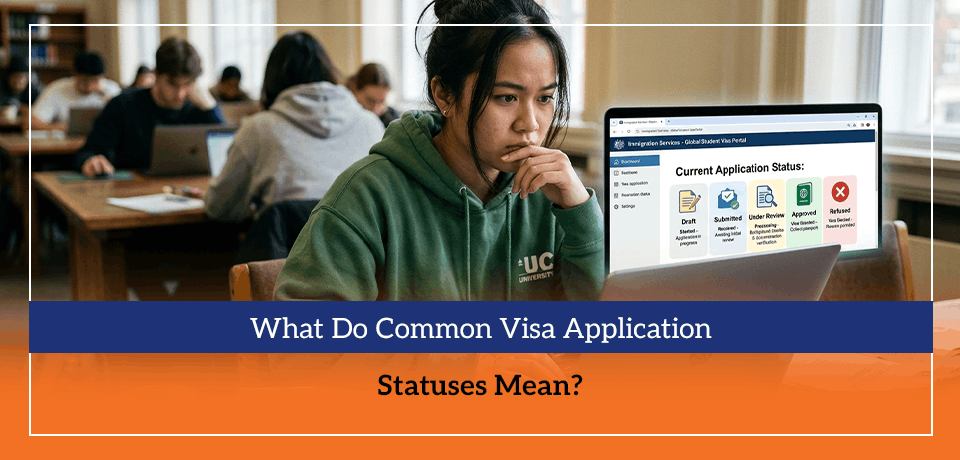
What Do Common Visa Application Statuses Mean?
Status labels are set by each authority, so the same stage carries different names in different systems.
|
Status
|
General meaning
|
|
Submitted
|
The application has been submitted
|
|
Received
|
The authority has received the application
|
|
In Process / Under Review
|
Assessment is underway
|
|
Additional Documents Required
|
The authority needs further information
|
|
Administrative Processing
|
Additional checks or review may be taking place
|
|
Decision Made
|
A decision has been reached
|
|
Approved
|
The application has been approved
|
|
Issued
|
The visa has been issued
|
|
Refused / Denied
|
The application was unsuccessful
|
|
Passport Ready for Collection
|
The passport is ready for collection or delivery
|
Australia shows how much the wording varies. ImmiAccount moves an application through Submitted, Application received, Information requested, Assessment in progress and then Finalised. Finalised means a decision has been made and will be sent to you by email or post. It does not mean the application succeeded.
What If Your Visa Status Is Not Showing?
An empty result is usually a lookup problem rather than a lost application.
“No Record Found”
Work through the mechanical causes first, because they account for most of these results:
- the passport number was entered with a transposed digit, or taken from a renewed passport rather than the one used to apply;
- the application number was mistyped, or a leading zero was dropped;
- the wrong visa category or application type was selected;
- the wrong embassy, visa office or processing location was chosen;
- the surname was entered differently from the application form, which is common where a name has no fixed given-name and surname split;
- the application has not yet been loaded into the tracking system;
- the check was run on the wrong portal, which happens wherever one country runs several.
Several systems also show nothing until a receipt or acknowledgement has been issued, so a blank result in the first days after applying carries no information either way.
No Recent Status Update
Long gaps between updates are normal on most routes. Authorities frequently ask for documents by email and treat silence as a missed deadline, so your inbox and spam folder are the first places to look.
Look inside the relevant immigration account as well as the public tracker, and review the official processing-time guidance for your route. Contact the authority once your case is genuinely outside the published timeframe.
If the result is a refusal, the next decision is about what changed rather than how quickly you can reapply. It is worth reading what to consider after a previous UK refusal before resubmitting.
Visa Application Status vs Visa Validity vs Passport Tracking
A valid visa and a pending application can both be true at once, and no single portal shows both.
|
Term
|
Meaning
|
|
Visa Application Status
|
Shows the progress or result of a visa application
|
|
Visa Validity
|
Shows whether an already granted visa is currently valid
|
|
Passport Tracking
|
Shows the physical passport’s delivery or collection progress
|
Australia is where this matters most, because VEVO answers the middle question and says nothing about the first. Passport tracking is a third system again, usually run by the visa application centre that took your biometrics. A passport moving through courier stages tells you a decision exists without telling you what it is.
Frequently Asked Questions
Can I check my visa status using only my passport number?
Usually no. Most systems need the application number or reference issued to you, with the passport number as a supporting detail.
Can I check visa status without an application number?
Rarely. Canada’s written enquiry form accepts a passport number and issuing country instead. The live trackers in the US, UK and Australia need the application reference or an account sign-in.
How do I know whether my visa has been approved?
By the notification, not the tracker. The UK confirms decisions by letter or email, and most authorities send the outcome directly rather than posting it to a public status page.
Why does my visa status say “No Record Found”?
Most often a mistyped digit, a renewed passport, the wrong portal, or an application not yet loaded into the system. Recheck the details against your confirmation receipt first.
Can I check UK visa status using a passport number?
No. There is no public GOV.UK lookup by passport number. You can monitor your UKVI account, your email, and your GWF or UAN reference.
What information do I need to check a visa application online?
The application or case number, your passport number, your date of birth and surname as submitted, and often the location you applied at.
Conclusion
Being able to check visa status with passport number details is real but partial. Treating the passport as the whole key is what sends most people to the wrong page.
Use the official portal for the country deciding your case, and keep the application number, reference number or account login from your confirmation receipt. Read the result against that authority’s own vocabulary rather than a general one.
If you are applying to study abroad and want professional support with your visa process, our team can help you track and manage it properly.