Choosing the best country to study medicine is one of the most important decisions a future doctor will make. Unlike many other degrees, a medical qualification does not automatically transfer across borders. Its real value depends on three connected factors:
- whether the degree is internationally recognised,
- whether graduates are eligible to take the required licensing exams in their chosen destination, and
- whether there is a realistic pathway into internship or residency.
This guide compares different countries based on key factors such as recognition, access to postgraduate training, and overall cost. Instead of relying only on rankings, it focuses on real-world outcomes that affect your long-term career.
Regulations can vary depending on your citizenship, medical school accreditation status, and where you plan to practise. Throughout this guide, readers are encouraged to verify all information through official regulators and trusted sources such as the World Directory of Medical Schools and the World Federation for Medical Education.
Best Countries to Study Medicine in 2027 (Shortlist by Goal)
"Best" is not one fixed answer. It depends on where you want your medical career to go after graduation. Some countries stand out for global reputation, research strength, and top-ranked medical schools globally. Others attract students through affordable, English-taught medical programmes, strong clinical exposure, and recognised qualification pathways.
Here's the thing: the country with the highest-ranked university is not always the right choice. A student aiming for medical residency in the USA may need a completely different pathway from someone planning a career in the UK or Australia. Think about it this way: recognition, clinical training, and licensing opportunities often matter more than a university name alone.
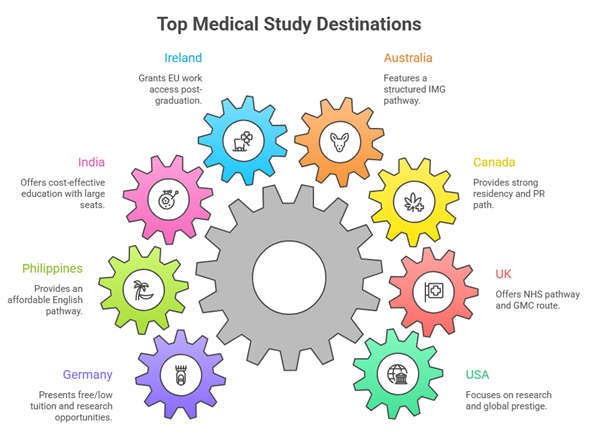
The table below compares leading destinations for students planning to study medicine in 2027. It focuses on practical goals rather than a simple ranking.
|
Country
|
Best For
|
Entry Route
|
Language
|
Cost Band
|
Career Pathway
|
Licensing Notes
|
Recognition Check
|
|
USA
|
Research & global medical prestige
|
Graduate-entry MD (4 yr)
|
English
|
Very High
|
Residency, research, and specialist training opportunities
|
ECFMG + USMLE + residency pathway
|
LCME accreditation required
|
|
UK
|
NHS pathway & GMC route
|
Undergraduate MBBS (5–6 yr)
|
English
|
High
|
Clinical training and postgraduate medical opportunities
|
GMC registration + PLAB (if IMG)
|
Check PMQ on GMC site
|
|
Canada
|
Healthcare system & residency opportunities
|
Medical degree pathway (4–5 yr)
|
English / French
|
High
|
Residency and professional development pathways
|
MCCQE + provincial licence requirements
|
Verify through recognised medical directories
|
|
Australia
|
Structured IMG pathway
|
Undergraduate MBBS (5–6 yr)
|
English
|
High
|
Clinical training and healthcare career opportunities
|
AMC exam + supervised practice
|
AMC / AHPRA listing
|
|
Ireland
|
English medical education & clinical training
|
Undergraduate Medicine (5 yr)
|
English
|
High
|
Healthcare careers and postgraduate opportunities
|
Medical Council registration
|
EU-recognised institutions
|
|
India
|
Cost-effective medical education & large intake capacity
|
Undergraduate MBBS (5.5 yr)
|
English (instruction)
|
Low
|
Wide medical education network
|
Country-specific licensing requirements
|
WHO/WDoMS listing critical
|
|
Philippines
|
Affordable English medical pathway
|
Undergraduate MD (4–6 yr)
|
English
|
Low–Mid
|
International medical education pathway
|
Requires destination-country licensing assessment
|
WFME-listed schools recommended
|
|
Germany
|
Research & affordable tuition options
|
Undergraduate Medizin (6 yr+)
|
German (required)
|
Low
|
Research and European healthcare opportunities
|
Approbation + language requirements
|
EU-accredited programmes
|
Risk & Limits: When This May Not Be the Right Choice
Choosing a country based only on tuition fees or rankings can create problems later. A lower-cost medical degree is not always the easier route if recognition, clinical exposure, or licensing requirements do not match your future plans.
- Private or unaccredited schools: A medical programme may look attractive because of English instruction or lower fees, but poor recognition can create challenges when applying for licensing pathways.
- Limited clinical exposure: Strong classroom teaching is not enough. Students need meaningful patient interaction and practical training. For example, a programme with modern laboratories but limited hospital rotations may not provide the experience required for future medical practice.
- Study-practice mismatch: A common mistake is choosing a country without checking where graduates usually continue their medical careers. A student studying in one country and planning to practise in another should understand exam requirements, language expectations, and residency pathways early.
A surprising point many students miss: the cheapest option is not always the most affordable in the long run. Extra exams, delayed training, or additional requirements can increase both time and cost. The right choice starts with your career goal, then works backwards to the country and university.

How to Choose the Best Country for Medicine (Decision Framework)
The right country is the one that aligns with where you intend to practise, fits your budget, matches the language of your future clinical environment, and offers a licensing and residency pathway that you can realistically complete. A structured scoring approach prevents the most common mistake: choosing a country that looks affordable on paper but turns out to be a unworkable for licensing in your target destination.
10-Minute Scoring Rubric
Score each criterion from 0 to 3 using the definitions below. A total of 18 or above across eight criteria suggests strong alignment. Below 14, reconsider your shortlist.
|
Criterion
|
Score 0
|
Score 1–2
|
Score 3
|
Where to Verify
|
|
1. Practice Destination Fit
|
No clear link to target country
|
Partial alignment
|
School + pathway aligns with target country requirements
|
Research target country regulator website
|
|
2. School Recognition
|
Not listed on WDoMS / WFME recognised directories
|
Listed but with limitations
|
Fully accredited & recognised institution
|
World Directory of Medical Schools (WDoMS) / recognised accreditation sources
|
|
3. Clinical Language
|
Mismatch with patient communication requirements
|
Supplementary language support available
|
Clinical training delivered in the language required for practice
|
Programme handbook / university website
|
|
4. Internship / Residency Access
|
No clear pathway after graduation
|
Some pathway exists; competitive
|
Clear supervised practice or residency pathway
|
Licensing bodies / official programme information
|
|
5. Total Cost & Funding Opportunities
|
Exceeds realistic budget
|
Manageable with financial planning
|
Affordable options with scholarships or funding opportunities available
|
University fee pages / scholarship portals
|
|
6. Career Opportunities
|
Limited information on career progression
|
Some opportunities available
|
Clear career development and professional progression opportunities
|
University career services / official resources
|
|
7. Safety & Student Support
|
Limited student support services
|
Adequate services available
|
Strong academic support and student wellbeing services
|
University resources / student reviews
|
|
8. Timeline
|
Longer than expected pathway
|
Requires additional exams or training stages
|
Achievable timeline based on programme structure
|
Programme structure & licensing timeline
|
A score of 18 or above across the eight criteria suggests that a country may align well with your academic and career goals. If two or more countries score similarly, consider the factors most important to your personal priorities, such as clinical training quality, accreditation, career pathways, or affordability.
Do not ignore a low score in key areas such as school recognition, clinical training, or professional pathway planning, as these factors can significantly affect your future opportunities.
Non-Negotiables Before You Apply
- Confirm that the medical school appears on the World Directory of Medical Schools (WDoMS) or an equivalent recognised directory.
- Verify that graduates of your chosen school meet the eligibility requirements for professional licensing in your target country.
- Check that clinical rotations are conducted according to the standards and language requirements of your intended practice destination.
- Confirm that a structured internship, supervised practice, or clinical training pathway exists after graduation.
- Obtain written confirmation of the programme structure, including clinical placement locations and durations.
Update Cadence (Important)
- University admission requirements & funding opportunities: Review before applying
- Licensing pathways & professional requirements: Recheck annually or when regulators update guidance
- School recognition status: Recheck before enrolment and before graduation

Medical Degree Recognition and Licensing Pathways
A medical degree is only as valuable as the regulatory system that recognises it. Even a prestigious qualification means little if it cannot be converted into a licence to practice in your chosen country.
This section maps the core pathways for the four most common practice destinations and explains what must be true about both the medical school and the graduate.
1. USA: ECFMG, USMLE, Residency
For international medical graduates (IMGs) aiming to practise in the United States, the pathway begins well before graduation. First, confirm that your medical school is eligible for ECFMG certification - not every school outside the USA qualifies.
Next, plan your USMLE steps:
Step 1 tests foundational science,
Step 2 CK tests clinical knowledge, and
Step 3 assesses readiness for unsupervised practice.
Residency is the main gateway to independent practice in the USA; without matching into a residency programme, a graduate cannot legally work as a physician, so plan early if you are considering studying in the United States. Check school eligibility on the ECFMG site and use official USMLE pages for exam definitions and registration.
2. UK: GMC Recognition and PLAB Route
Graduates of overseas medical schools who wish to practise in the United Kingdom must first confirm that their primary medical qualification (PMQ) is acceptable to the General Medical Council if they are aiming to become a doctor through the UK route. If it is, the most common route is to sit PLAB, the Professional, Statutory and Regulatory Bodies Examination.
English language proficiency and supporting documentation are checked at every stage, so confirm the accepted English language tests early. Once PLAB is passed, the graduate can apply for GMC registration and proceed to foundation training. UK rules can and do change; always confirm current requirements on the GMC and GOV.UK websites before acting on any guidance, especially if you are studying in the UK as an international student.
3. Canada: MCC Exams and Provincial Pathways
Canada does not operate a single national licensing pathway. The Medical Council of Canada Qualifying Examination Part I (MCCQE Part I) is the key national assessment that all graduates must pass, but the route into supervised practice and full licensure varies from province to province.
Residency access for international medical graduates is competitive and depends on matching through provincial programmes. Prospective students must research the specific requirements of the province where they intend to practise, not simply assume that passing the MCC exams is sufficient when studying in Canada.
4. Australia: AMC and Medical Board Pathways
The AMC examination is the standard test for international medical graduates aiming to register in Australia. After successfully passing the AMC exam or an equivalent workplace-based assessment, graduates are required to complete a period of supervised practice-usually one to two years, depending on the state or territory-before they can obtain full registration with the Medical Board of Australia and AHPRA.
Verify current eligibility and pathway details directly through the AMC and AHPRA websites, as conditions and timelines are updated periodically for those studying in Australia.
Cost to Study Medicine Abroad
The table below provides a framework for building a country-level budget. Use it before you shortlist - not after you have already become emotionally attached to a particular university.
|
Cost Category
|
Estimate Range
|
Notes
|
|
Tuition (per year)
|
£5,000 - £45,000+
|
Varies hugely by country, university, and citizenship status
|
|
Rent & Accommodation
|
£400 - £1,800 / month
|
City location and lifestyle choices are major factors
|
|
Transport & Food
|
£200 - £600 / month
|
Budget more in high-cost cities
|
|
Health Insurance
|
£100 - £500 / year
|
Requirements vary by country and healthcare system
|
|
Licensing Exam Fees
|
£300 - £2,500 total
|
USMLE, PLAB, MCCQE, AMC – each varies
|
|
Application & Administrative Fees
|
£50 - £1,000+
|
Include university and document-related costs where applicable
|
|
Travel & Emergencies
|
£1,000 - £3,000 / year
|
Always maintain an emergency buffer
|
|
Total (rough annual)
|
£10,000 - £55,000+
|
Confirm with each university's official fee page
|
Costs aren’t the same everywhere. They change depending on the country, city, university, citizenship status, and whether you’re applying for undergraduate or graduate-entry medicine.
Scholarships and Funding Opportunities
Funding opportunities for medical students vary by country, university, and eligibility criteria. Government-funded scholarships, such as the UK's Chevening or Australia's Australia Awards, can provide financial support but usually have specific eligibility requirements and conditions.
University-level scholarships, bursaries, and funding opportunities may offer additional support and are often more specific to academic performance, nationality, or study programme. Students should review scholarship deadlines and eligibility criteria well in advance as part of their overall study planning.

Entry Routes and Language: MBBS vs MD
Medical education is structured differently around the world. Many countries offer an undergraduate-entry MBBS or MBChB, typically lasting five to six years, and you should also review postgraduate options in the UK after an MBBS if that is your intended route. Others, most notably the United States, emphasise a graduate-entry MD that assumes a prior bachelor's degree in a science discipline.
|
Feature
|
Undergrad MBBS / MBChB
|
Grad-Entry MD
|
Who It Fits
|
Key Consideration
|
|
Typical Duration
|
5–6 years
|
4 years (post-bachelor)
|
School leavers vs. career changers
|
Undergrad includes pre-clinical; MD assumes prior science base
|
|
Prerequisites
|
A-level / IB sciences
|
Bachelor's degree (science preferred)
|
Age & academic stage matter
|
MD requires strong science foundation & MCAT/equivalent
|
|
Clinical Exposure
|
Integrated from Year 3
|
Intensive rotations from Year 2–3
|
Both models deliver clinical hours
|
Confirm placement language matches licensing country
|
|
Cost Implication
|
Higher total spends (longer)
|
Lower total but higher annual fees
|
Budget over full duration
|
Include opportunity cost of extra years for undergrad path
|
|
Post-Grad Flexibility
|
Broad; recognised in most countries
|
Strong in country of study; check abroad
|
Practice destination drives choice
|
Verify international recognition before enroling
|
Career Pathways After Graduation
Studying medicine abroad is only truly "best" when it provides a clear pathway towards clinical training, professional registration, and long-term career development. A medical degree is the foundation of your medical journey, but your future opportunities also depend on licensing requirements, internship availability, residency pathways, and healthcare system structure.
Each country has its own medical registration process, postgraduate training system, and professional requirements. These requirements can change over time, so students should always verify the latest information through official university, government, and medical regulatory sources.
1. UK: GMC Registration and Clinical Training Pathway
The UK offers a structured pathway for medical graduates through professional registration with the General Medical Council (GMC) and access to postgraduate medical training opportunities.
For international graduates, completing the required registration steps, meeting English language requirements, and understanding the foundation training pathway are important considerations when planning a medical career in the UK.
2. Canada: Medical Residency and Licensing Pathway
Canada provides opportunities for medical graduates through its structured healthcare system and postgraduate training pathways.
International medical graduates may need to complete specific assessments and meet provincial licensing requirements before progressing towards medical practice. Residency opportunities can be competitive, making early planning and understanding the requirements essential.
3. Australia: AMC and Medical Registration Pathway
Australia provides a recognised pathway for medical graduates through professional assessment, supervised clinical practice, and medical registration processes.
International graduates may need to complete AMC examinations, meet registration standards, and fulfil supervised practice requirements before practising independently.
Professional registration, clinical training opportunities, and career pathways vary between countries. Students should choose a medical destination based on recognition, training quality, licensing pathway, and their long-term career goals.

Frequently Asked Questions
What is the best country to study medicine for international students?
There’s no definitive answer as to which country is the best. The ideal choice varies based on your practice goals, budget, language proficiency, and the licensing route you have to follow. Use the scoring rubric in Section 3 to compare options systematically rather than relying on rankings alone.
Which country has the cheapest recognised medical degree?
India and the Philippines offer lower tuition, but graduates must still pass relicensing exams abroad. A low-cost degree that is not recognised in your target country has limited practical value. Always cross-reference cost with WDoMS listing status before committing.
Which country is best if the goal is to practise in the USA?
As long as the ECFMG approves the medical schools in these countries, they can be excellent choices. However, getting into a residency program in the United States is very competitive for international graduates. Students usually need strong scores in the USMLE, along with solid clinical experience, to stand out. Before applying anywhere, it is important to check your school’s eligibility directly on the ECFMG website.
Is studying medicine in English enough to practise abroad?
Not necessarily. The language of instruction and the language of clinical practice can differ significantly. Licensing countries set their own language requirements independently of your degree language. Always check the clinical rotation language, not just the lecture language.
How do you check if a medical school is recognised internationally?
Use the World Directory of Medical Schools (WDoMS) and WFME listings as your first checks. For USA-specific plans, verify on the ECFMG school eligibility list. These directories do not guarantee licensure but are the most reliable starting points.
Which is better: MBBS abroad or MD at home?
This depends on your circumstances. An MBBS abroad can open international doors, but only if the school is recognised and you can complete the licensing exams in your target country. An MD at home avoids immigration and recognition risks. Compare both options using the framework in Section 3.
To conclude
The best country to study medicine is the one that matches your intended practice destination, keeps your medical school recognised, and provides a realistic, end-to-end plan for licensing exams, supervised practice, residency opportunities, funding and scholarship options - all within your academic goals, budget considerations, and language requirements.
Your next steps are clear:
- Shortlist three to five countries using the framework in this guide.
- Verify school recognition via WDoMS,
- Confirm your target licensing pathway through ECFMG, GMC, MCC, or AMC, and
- Review academic requirements, funding opportunities, scholarships, and professional registration information through official sources.
Every step should be verified, not assumed.