The top public universities in USA offer exceptional teaching, research and opportunities across subjects such as engineering, computer science, business and public health. But the highest-ranked university is not automatically the right choice for every student, particularly when international tuition and living expenses enter the picture.
For 2027, UC Berkeley and UCLA share the No. 1 position in the U.S. News Best Colleges ranking of public universities. The University of Michigan, University of Virginia and UNC Chapel Hill follow. This guide compares the latest ranking, leading courses, published undergraduate costs, scholarship availability and practical considerations for students planning to enter university in autumn 2027.
What is the number 1 public university in the USA?
UC Berkeley and UCLA are jointly ranked No. 1 among public universities in the USA in the 2027 U.S. News Best Colleges rankings. Both institutions also share 20th place in the overall national universities ranking, which includes private institutions.
There is no single winner across every league table. Rankings measure different things. A student who prioritises computer science, for example, may prefer Berkeley, Georgia Tech or Illinois, while another interested in public health may shortlist UNC Chapel Hill or Michigan. Start with the ranking, then look closely at the course and its actual cost.
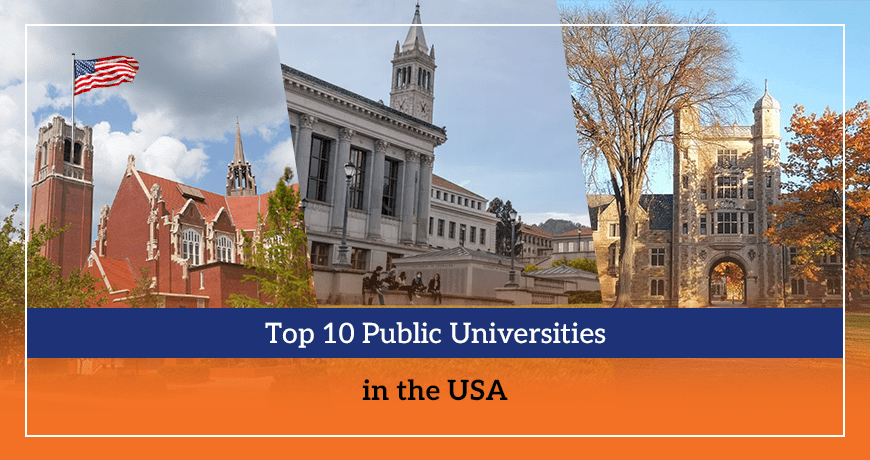
Top 10 public universities in USA: 2027 rankings
The following table shows how the top public universities in USA are placed in the 2027 U.S. News Top Public Schools ranking, published in September 2026, rather than last year's figures.
|
2027 public rank
|
University
|
State
|
Well-known academic strengths
|
|
=1
|
University of California, Berkeley (UC Berkeley)
|
California
|
Computer science, engineering, economics
|
|
=1
|
University of California, Los Angeles (UCLA)
|
California
|
Life sciences, psychology, film, engineering
|
|
3
|
University of Michigan, Ann Arbor
|
Michigan
|
Engineering, business, public policy
|
|
4
|
University of Virginia (UVA)
|
Virginia
|
Business, politics, humanities
|
|
5
|
University of North Carolina at Chapel Hill (UNC)
|
North Carolina
|
Public health, journalism, business
|
|
=6
|
Georgia Institute of Technology (Georgia Tech)
|
Georgia
|
Engineering, computing, robotics
|
|
=6
|
University of California, San Diego (UC San Diego)
|
California
|
Biology, biotechnology, computer science
|
|
=8
|
University of California, Davis (UC Davis)
|
California
|
Agriculture, environmental science, biology
|
|
=8
|
University of California, Irvine (UC Irvine)
|
California
|
Computing, health sciences, social sciences
|
|
=8
|
University of Florida
|
Florida
|
Engineering, business, agricultural sciences
|
|
=8
|
University of Texas at Austin (UT Austin)
|
Texas
|
Engineering, business, computer science
|
|
=8
|
University of Illinois Urbana-Champaign (Illinois)
|
Illinois
|
Engineering, computer science, accountancy
|
|
=8
|
University of Wisconsin-Madison (UW-Madison)
|
Wisconsin
|
Economics, life sciences, business
|
Why are there 13 names in a Top 10 list? U.S. News records tied positions. Two universities share first place, two share sixth and six share eighth. Removing three institutions to force a ten-row table would misrepresent the published result. The University of California's 2027 ranking announcement confirms the leading UC positions.
These are overall undergraduate university rankings, not rankings for every degree. A lower overall position can still come with an outstanding department in your chosen subject.
Best public universities in USA: which one suits you?
UC Berkeley and UCLA: two universities, one top ranking
UC Berkeley combines demanding academics with particular strength in computing, economics, engineering and research. The Bay Area location brings proximity to technology firms and start-ups, although housing costs can be substantial. Berkeley makes sense for applicants comfortable with highly competitive admissions and a substantial nonresident budget.
UCLA offers breadth across psychology, biological sciences, engineering, the arts and film. Los Angeles is a distinctive setting for students interested in media, health, science or the creative industries. UCLA's undergraduate funding restrictions for international students deserve attention before it goes on an application shortlist.
University of Michigan: breadth and a major research environment
Michigan's Ann Arbor campus brings together engineering, social sciences, business, health-related fields and large-scale research. It is a strong choice for students who want to explore connections between disciplines. Its nonresident fees are high, however, and admission to individual schools or majors may involve separate requirements.
University of Virginia and UNC Chapel Hill: academic depth with different strengths
UVA, in Charlottesville, is especially attractive for politics, humanities, commerce and public policy. Costs differ across its undergraduate schools, so an arts and sciences budget should not be treated as the price of every UVA degree.
UNC Chapel Hill is well known for public health, journalism, business and the liberal arts. Its North Carolina setting also connects students to research and healthcare organisations. Both universities are selective, and nonresident applicants should check any additional admission restrictions that apply to their programme.
Georgia Tech and UC San Diego: strong STEM choices
Georgia Tech's specialist focus makes it especially compelling for engineering, computer science, analytics and robotics. For a student set on mechanical engineering or computing, the strength of the specific department may matter more than a difference of a few places in an overall league table.
UC San Diego offers a different mix: biotechnology, biology, oceanography, engineering and computer science. Its location supports links with laboratories, healthcare and the Southern California research community. Compare its college structure, major-entry rules and housing budget before applying.
The six universities tied at eighth
The institutions sharing eighth place serve very different interests. UC Davis is an obvious candidate for agriculture, food science, veterinary-related pathways and environmental research. UC Irvine suits students considering computing, health sciences and social science in Orange County.
Florida offers a broad research university environment, including engineering, agricultural sciences and business. UT Austin is attractive for technology, entrepreneurship, business and engineering, with Austin providing a lively employment market. Illinois Urbana-Champaign has particular depth in engineering, computer science and accountancy. Wisconsin-Madison offers strength across economics, science, psychology and business.
Finding the best public universities in USA for your goals takes more than comparing positions on a list. Compare the degree curriculum, departmental facilities, class structure and cost alongside the university's overall reputation.
Top 20 public universities in USA: the next ranked institutions
The 13 universities in the first table occupy ranking positions 1 through 8. Eight more institutions appear at positions 14, 17 and 19, bringing the 2027 Top 20 public university ranking group to 21 universities because of ties.
|
2027 public rank
|
University
|
State
|
Notable areas to explore
|
|
=14
|
University of California, Santa Barbara (UC Santa Barbara)
|
California
|
Physics, environmental studies, engineering
|
|
=14
|
Ohio State University
|
Ohio
|
Business, engineering, health sciences
|
|
=14
|
Rutgers University, New Brunswick
|
New Jersey
|
Pharmacy, life sciences, business
|
|
=17
|
University of Maryland, College Park
|
Maryland
|
Computer science, engineering, public policy
|
|
=17
|
University of Washington, Seattle
|
Washington
|
Computing, public health, research
|
|
=19
|
University of Georgia
|
Georgia
|
Business, agriculture, journalism
|
|
=19
|
Virginia Tech
|
Virginia
|
Engineering, architecture, agriculture
|
|
=19
|
William & Mary
|
Virginia
|
Government, history, business
|
The positions are corroborated by 2027 announcements from Rutgers, the University of Maryland and the University of Georgia, alongside the UC ranking release cited above. The table extends the top 20 public universities in USA without quietly adding universities that sit outside the ranking group.
Purdue, Texas A&M and other well-known public universities may also be worth considering for specific courses, but they are not being presented here as members of this particular 2027 Top 20 ranking. Purdue, for instance, is especially strong in engineering and computing; it is an alternative to assess on departmental fit rather than an assumed overall Top 20 position. For a regional comparison, explore leading universities across the American Midwest.
Are Top 50 and Top 100 public university lists useful?
Yes, particularly when you need more attainable or specialist options. Searches for the top 50 public universities in USA or top 100 public universities in USA should lead to a consistently sourced, complete list rather than an invented continuation of the top twenty. For context, U.S. News places UC Santa Cruz 50th among public universities in 2027. Always confirm the ranking year and compare departmental quality, admission requirements and total costs before extending your shortlist.
How public university rankings differ
U.S. News considers measures such as graduation and retention, academic resources, reputation and graduate outcomes. Its 2027 methodology also includes an earnings-by-major measure. Niche draws on different data and student experience indicators, while global rankings often emphasise research performance and international reputation.
That explains why rankings can disagree without either list necessarily being useless. The smarter approach is to use one published ranking for the numbered list, then assess degree-specific quality separately. You can also check institutional graduation, cost and outcomes data through the US Department of Education's College Scorecard.
Students wanting to compare leading public institutions with private universities such as Stanford, Harvard or MIT should make that a separate exercise. A broader selection of US universities for overseas applicants addresses that different question without confusing public-only rankings.
Best state universities in USA by subject and location
A public university typically receives support from its state, but state university does not mean that every applicant pays the in-state fee. International students usually face nonresident charges unless a specific exemption applies.
|
Student priority
|
Public universities worth comparing
|
|
Computer science and AI
|
UC Berkeley, Georgia Tech, Illinois, UT Austin, UC San Diego
|
|
Engineering
|
Georgia Tech, Michigan, Illinois, Purdue, Texas A&M
|
|
Business and economics
|
Michigan, UVA, UT Austin, UNC, Wisconsin
|
|
Biology and public health
|
UC San Diego, UNC, Michigan, Florida, Washington
|
|
Agriculture and environmental science
|
UC Davis, Florida, Wisconsin, Texas A&M
|
|
Media, arts and psychology
|
UCLA, Michigan, Wisconsin, UNC
|
Consider a student choosing between UC Davis and a higher-ranked general university for food science. Davis could be the better academic match because its specialist teaching and research align more closely with that career goal. That is the value of checking the department rather than treating the main ranking as the final answer.
Your intended qualification matters too. These rankings primarily concern undergraduate institutions. If you are considering a master's degree, explore subject-led postgraduate options in the US instead of assuming an undergraduate league table predicts graduate programme quality.
Public university tuition fees and costs for international students
Here's the catch: public does not necessarily mean inexpensive for international students. One detail families often miss is that an advertised resident fee may have little to do with what an overseas applicant pays. Universities may advertise resident tuition prominently, but overseas applicants often pay a separate nonresident rate. Then come accommodation, food, insurance, books, transport and personal expenses.
The figures below are published undergraduate estimates, not confirmed Fall 2027 bills. Unless stated otherwise, they use the 2026-27 academic year and the specified living or programme assumptions. Figures include different components at different institutions, so check the notes before making a like-for-like comparison.
|
Public university
|
Published indicative annual cost
|
Basis
|
|
UC Berkeley
|
$93,944
|
New nonresident, campus residence hall; includes $39,270 supplemental tuition
|
|
UCLA
|
$84,770
|
New nonresident, on-campus undergraduate budget
|
|
Michigan
|
$88,394
|
Nonresident, lower-division undergraduate budget
|
|
UVA
|
$83,286 to $84,976
|
First-year nonresident Arts & Sciences; health insurance may be additional
|
|
Georgia Tech
|
$56,520
|
First-year out-of-country, living on campus
|
|
University of Florida
|
$54,010
|
Out-of-state undergraduate standard budget
|
|
UT Austin
|
$64,204 to $72,916
|
Nonresident, course-dependent undergraduate estimate
|
|
Illinois Urbana-Champaign
|
$62,050
|
International undergraduate, base-rate programme, 12 credits
|
|
UC Davis
|
$88,279
|
New nonresident, campus residence hall
|
|
UC Irvine
|
about $84,476
|
New nonresident, on-campus; $45,206 resident estimate plus $39,270 supplement
|
The Berkeley calculation deserves particular care. Its $54,674 residence-hall budget is not the full estimate for a new international undergraduate. Adding the published $39,270 nonresident supplemental tuition brings the indicative total to $93,944. Missing that supplement would distort the comparison by nearly $40,000.
UVA lists a separate annual student health plan of $4,220 for 2026-27 where the student does not have acceptable alternative cover. Other universities may also charge health insurance or programme-specific fees beyond a headline estimate. Georgia Tech has published a 2027-28 first-year out-of-country on-campus estimate of $56,194, but the table above retains its 2026-27 figure for consistency. These amounts can change before Fall 2027 enrolment.
As a practical rule, compare tuition and fees, total cost of attendance, and estimated net cost after confirmed scholarships as three different figures. Do not subtract an award you have not received. It also helps to check how student health cover works in the USA before setting a yearly budget.

Scholarships at public universities in the USA
Scholarships exist, but opportunities for international undergraduates vary sharply between universities. A high ranking does not mean generous international funding. Some grants are reserved for state residents, while others depend on nationality, academic merit or a particular programme.
UC Berkeley publishes scholarship opportunities for eligible international undergraduates, while federal and state aid is generally unavailable to international undergraduates; some institutional awards may be need-based. UCLA states explicitly that it does not provide undergraduate scholarships or financial aid to students who are neither US citizens nor permanent residents, as detailed in its international applicant information. Michigan also warns that international undergraduate scholarship opportunities are very limited.
Funding can come from merit awards, departments, external foundations or schemes based in the student's home country. Check whether each award is open to international applicants, whether a separate application is necessary, its value, and whether it renews for later years. A $10,000 tuition award is meaningful, but it does not turn an $85,000 annual budget into a fully funded place.
Students can compare scholarship routes for US higher education, while applicants from Bangladesh may also wish to explore funding opportunities relevant to their country. Always confirm eligibility and award terms with the funding provider itself.
Public vs private universities in the USA
Public institutions usually receive state funding, while private universities rely more heavily on tuition, donations and other revenue. The important difference for applicants is not simply ownership. It is what the university charges you, for your course, after any confirmed scholarship.
A private institution can sometimes be cheaper than a public one for a particular international student if it offers substantial institutional aid. Conversely, a prestigious public university can be expensive once nonresident tuition is added. Compare the realistic net price and academic fit, not the public or private label alone.
Fall 2027 applications: dates and entry requirements
Application deadlines vary by university and applicant type. For the University of California's Fall 2027 first-year intake, the application opened on 1 August 2026 and the filing period runs from 1 October to 30 November 2026. The official UC admissions calendar is the reference for these dates.
Other public universities use their own early-action, priority, regular-decision or rolling-admission timetables. Do not assume that a November deadline at one institution applies to Michigan, Georgia Tech, Illinois or Florida. Check the exact campus and course before setting your application schedule.
Entry requirements can include school results, the recognised equivalent of a US high-school qualification, course-specific subjects, essays, references and evidence of English proficiency. Students should complete and submit their own applications in accordance with each institution's rules; some universities, including UCLA, explicitly do not endorse agents acting on their behalf. The accepted language tests and score thresholds differ between institutions. For an initial comparison of universities that consider Duolingo English Test scores, use the individual university's current undergraduate admissions rules as the final authority.
For a wider overview of choosing courses and preparing university applications, see the stages involved in studying at an American university. The US study destination overview is also useful when you need information beyond public-university rankings.
How to choose the right public university
Start with your subject, not the institution's headline position. Read module lists, check whether admission is directly to the major, and look at undergraduate research, accreditation where relevant, and opportunities to take electives.
Next, build a realistic annual budget using the nonresident rate. Then check admission selectivity and requirements for your chosen programme, followed by housing, location and any scholarship for which you are actually eligible. If a university looks attractive only because you have assumed an unconfirmed award, keep a more affordable option on the shortlist.
Finally, compare a small group side by side. Three well-matched universities with different levels of competitiveness can be more useful than twenty famous names chosen from a general ranking.

Frequently asked questions
What are the top 5 public universities in USA in 2027?
By ranking position, the leaders are UC Berkeley and UCLA (joint first), the University of Michigan (third), the University of Virginia (fourth) and UNC Chapel Hill (fifth). These are five universities occupying the first five rank positions, with a tie at number one.
Which university is No. 1 among public universities in the US?
UC Berkeley and UCLA share the No. 1 position in the 2027 U.S. News Best Colleges ranking. A different publisher may place one ahead of the other because ranking methods differ.
Are public universities in the USA cheaper for international students?
Not necessarily. Public universities often charge overseas students nonresident tuition, which can substantially increase the annual bill. Always compare the full budget, including accommodation and insurance, with any confirmed scholarship amount.
Which public university is best for engineering or computer science?
Georgia Tech, UC Berkeley, Illinois Urbana-Champaign, Michigan, UT Austin and UC San Diego are strong options to compare. The right choice depends on the precise major, teaching approach, research interests and admission requirements.
Do international students receive scholarships at US public universities?
Some do, but availability is institution-specific. Berkeley lists certain international scholarship opportunities; UCLA says it does not offer undergraduate institutional scholarships or financial aid to applicants who are not US citizens or permanent residents. Check eligibility carefully rather than assuming that awards advertised to domestic students apply to everyone.
Is a top 100 public universities in USA list useful?
Yes, especially for widening your shortlist beyond the most selective institutions. Use a consistent ranking year and publisher, then evaluate courses, nonresident costs and admission requirements individually. A rank alone cannot tell you whether a university is a suitable match.
Conclusion
The top public universities in USA are not simply the institutions with the highest number beside their names. For 2027, UC Berkeley and UCLA share first place, Michigan ranks third, UVA fourth and UNC Chapel Hill fifth, with Georgia Tech and UC San Diego tied for sixth. Six more universities share eighth place.
Use that ranking to build a shortlist, not to make the final decision. If you want engineering, Georgia Tech or Illinois might fit better than a more broadly ranked university. If you are interested in food science, UC Davis deserves serious attention. And if cost matters most, comparing the international annual budget can change your shortlist completely.
Choose a course you want to study, check the 2027 ranking and its methodology, verify the university's current entry requirements and calculate the full nonresident cost before applying. The best choice is one that works academically and financially, not simply the most famous name.
If you would like a second opinion on your course and university shortlist, get in touch to discuss your study options. University applications and admission decisions remain subject to each institution's own policies and requirements.