Looking for universities in Canada without IELTS for 2027? The good news is that IELTS is not the only way to prove your English language ability. Several Canadian universities accept alternatives such as Duolingo, TOEFL iBT, PTE Academic, CAEL, Cambridge English, qualifying previous English-medium education or their own language programmes.
But there is an important distinction.
Studying without IELTS usually does not mean studying without any proof of English. Your university still needs evidence that you can understand lectures, complete assignments and communicate effectively in English.
So, choose your programme first, check which English options it accepts, and then decide which route suits you. If you are still comparing courses and institutions, start by planning your Canadian study route.
Last reviewed: 10 August 2026. English requirements, tuition figures and study permit information in this guide were checked against official university and Government of Canada sources. Individual programmes may have different requirements.
Can You Study in Canada Without IELTS in 2027?
Yes. You can study in Canada without IELTS if your chosen university accepts another way of meeting its English language requirement.
Common alternatives include Duolingo English Test, TOEFL iBT, PTE Academic, CAEL and Cambridge English. Some institutions may also consider qualifying previous education completed in English or allow students to complete an academic English programme.
Here's the thing: Canada does not have one universal IELTS waiver for university admission. Each institution sets its own English requirements, and individual faculties can apply stricter standards.
That is why "without IELTS" should usually be understood as without IELTS specifically, rather than without English proficiency requirements.
Why Some Canadian Universities Do Not Require IELTS
Canadian universities need international students to demonstrate sufficient English proficiency, but IELTS is only one recognised method.
Many institutions accept several established English tests. Others consider certain types of previous education where English was officially used for teaching and assessment. Some universities also provide English language pathways for students who meet the academic requirements but not the direct English threshold.
Brock University, for example, can consider at least three years of qualifying full-time study where English was the primary language of instruction and evaluation. The University of Saskatchewan also recognises specific previous English-medium study routes.
The university is not removing its English standard. It is simply giving you more than one way to meet it.
Top 10 Canadian Universities Without IELTS Requirements
Below are 10 popular Canadian institutions where IELTS is not the only route for demonstrating English proficiency.
|
Institution
|
Common IELTS Alternatives
|
|
University of Winnipeg
|
Duolingo, TOEFL, PTE, CAEL, Cambridge, ELP
|
|
Brock University
|
Duolingo, TOEFL, PTE, CAEL, Cambridge, IELP
|
|
University of Saskatchewan
|
Duolingo, TOEFL, PTE, CAEL, Cambridge, previous English study
|
|
Memorial University
|
Duolingo, TOEFL, PTE, CAEL, Cambridge, English pathway
|
|
McGill University
|
Duolingo, TOEFL, PTE, CAEL, Cambridge
|
|
Concordia University
|
Duolingo, TOEFL, PTE, CAEL, Cambridge
|
|
Carleton University
|
Duolingo, TOEFL, PTE, CAEL, Cambridge, Academic ESL
|
|
University of Regina
|
Duolingo, TOEFL, PTE, CAEL, Cambridge, qualifying previous study
|
|
Seneca Polytechnic
|
Duolingo, TOEFL, PTE, CAEL, Cambridge
|
|
Okanagan College
|
Duolingo, TOEFL, PTE, CAEL
|
Seneca Polytechnic and Okanagan College are included because students researching this topic often compare university and college routes together.
1. University of Winnipeg
The University of Winnipeg offers several alternatives to IELTS. Current options include Duolingo 120, PTE Academic 58, CAEL 60, Cambridge English, TOEFL and successful completion of Academic Level 5 of its English Language Program.
The university also offers useful funding for new international students. Eligible undergraduates can receive an automatic International Special Entrance Scholarship of CAD 1,000, CAD 2,000 or CAD 3,000, depending on their converted admission average. Winter 2027 and Spring 2027 are included in the current schedule.
Check the university's current English language requirements before applying.
2. Brock University
Brock University accepts Duolingo, TOEFL, PTE Academic, CAEL and Cambridge English.
For standard undergraduate admission, current requirements include Duolingo 110, PTE 58 and CAEL 70. Students may also satisfy the English requirement by completing Level 5 of Brock's Intensive English Language Program.
Another useful option is previous English-medium education. Brock can consider at least three years of qualifying full-time study where English was the primary language of instruction and assessment.
You can compare the available routes through Brock's English proficiency requirements.
3. University of Saskatchewan
The University of Saskatchewan accepts several alternatives, including Duolingo 120, PTE Academic 63, CAEL 70, Cambridge C1 Advanced and TOEFL.
USask also recognises qualifying previous education completed in English. For post-secondary study outside Canada, the institution must officially use English as the language of instruction and examination under the university's stated conditions.
That makes USask relevant for students who already have substantial English-medium academic experience, but a simple MOI letter should not be assumed to guarantee an exemption.
Check the current English proficiency policy before applying.
4. Memorial University of Newfoundland and Labrador
Memorial University accepts several recognised alternatives to IELTS and also provides English language pathway options for applicants who do not meet direct entry requirements.
Memorial deserves particular attention if cost matters. For new international undergraduate students starting in the 2026/27 academic year, the university lists CAD 22,500 in tuition for two semesters at its St John's campus, before additional required fees.
Compare the university's English proficiency options with your chosen programme before making a decision.
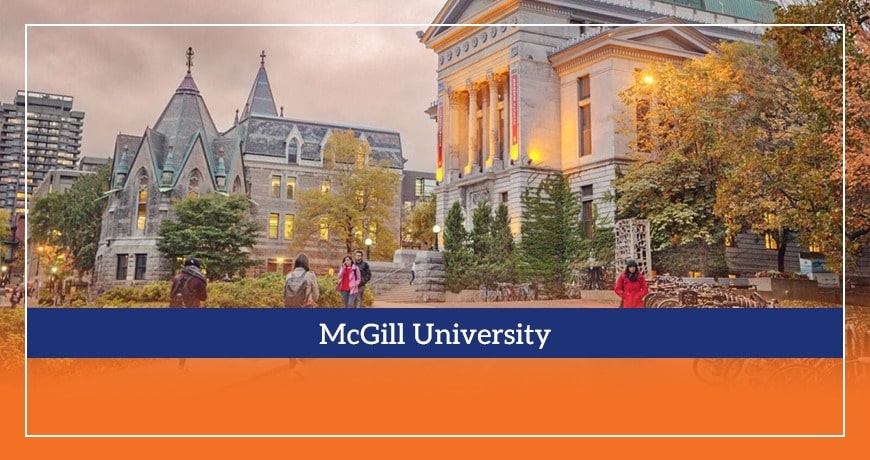
5. McGill University
McGill University accepts several alternatives to IELTS for undergraduate admission.
Current options include Duolingo 125 for many programmes, CAEL 70 and PTE Academic 65, subject to component scores and higher requirements for certain faculties.
There is an important detail here. Studying at an English-medium institution does not automatically give every undergraduate applicant an exemption. McGill applies specific exemption criteria.
Use McGill's current English proficiency requirements for the programme you intend to study.
6. Concordia University
Concordia University accepts Duolingo, TOEFL, PTE Academic, CAEL and Cambridge English.
Its current undergraduate requirements include Duolingo 105, PTE Academic 50 and CAEL 50, although some programmes require higher scores.
Concordia also has exemption rules based on qualifying previous education completed in English. This is another example of why "without IELTS" does not necessarily mean "without English evidence".
Review Concordia's current English language requirements before applying.
7. Carleton University
Carleton University offers both direct admission and admission with an Academic ESL requirement.
For direct undergraduate admission without additional ESL study, Carleton currently accepts Duolingo 120, PTE Academic 55 and CAEL 70, alongside TOEFL and Cambridge English.
Students with qualifying but lower English scores may be admitted to certain degree programmes while completing Academic ESL courses.
One useful detail is that Carleton does not treat a letter from an educator as an automatic English waiver. Check the university's English and ESL admission routes instead of relying on an informal MOI document.
8. University of Regina
The University of Regina accepts several IELTS alternatives for most undergraduate programmes.
Current general requirements include Duolingo 120, PTE Academic 59 and CAEL 60, alongside TOEFL and Cambridge English.
Programme-specific rules matter here. The Faculty of Nursing currently applies separate English proficiency rules and accepts IELTS Academic for its test route.
So, always check your faculty rather than relying only on the general university requirement.
9. Seneca Polytechnic
Seneca Polytechnic is particularly relevant for students considering college, degree or graduate certificate routes.
Seneca accepts Duolingo, TOEFL, PTE Academic, CAEL and Cambridge English. Current Duolingo requirements generally range from 105 to 110 for certificate and diploma programmes, 115 to 120 for degrees, and 120 to 125 for master's and graduate certificate programmes. PTE Academic currently starts at 58 for certificate and diploma programmes and 60 for degree and graduate-level study.
Check Seneca's current international English requirements for your programme.
10. Okanagan College
Okanagan College accepts several English proficiency documents from international applicants, including Duolingo, TOEFL, CAEL and PTE.
The exact requirement depends on the programme, so this is not a case where one score applies across every course.
Okanagan can be useful for students who prefer a college route or need additional English preparation before academic study. Check the international application requirements together with your programme page.
Are There Affordable Universities in Canada Without IELTS?
Yes, but English requirements and tuition costs are two separate considerations.
If you are searching for the cheapest university in Canada without IELTS, first confirm that the university accepts an English option you can realistically use. Then compare the cost.
Memorial University provides a useful current benchmark. New international undergraduate students at its St John's campus pay CAD 22,500 in tuition for two semesters in 2026/27, before other compulsory fees.
The University of Winnipeg, meanwhile, offers eligible new international undergraduates automatic entrance scholarships of CAD 1,000 to CAD 3,000.
If budget is one of your main filters, compare lower-cost Canadian university options alongside the English requirements. You can also explore funding opportunities in Canada.
Here is the mildly surprising part: avoiding IELTS is not always the cheapest route. If a university English programme adds an extra term of tuition, taking one recognised English test may cost less overall.
Alternatives to IELTS Accepted by Canadian Universities
Several forms of English evidence can replace IELTS at institutions that officially accept them.
Alternative English Tests
The most common options include:
- TOEFL iBT
- PTE Academic
- Duolingo English Test
- CAEL
- Cambridge C1 Advanced or C2 Proficiency
Acceptance and minimum scores vary by university and programme.
If an online test suits you better, you can compare Canadian institutions accepting Duolingo before booking the exam.
One practical mistake happens surprisingly often. Students take a test first, then discover their preferred programme does not accept it.
Reverse the order. Choose the programme first, then choose the test.
Previous English-Medium Education and MOI
Some Canadian universities may consider qualifying previous education completed in English.
This is where Medium of Instruction, or MOI, becomes relevant.
An MOI document can help show that your previous studies were taught in English, but it is not a universal substitute for IELTS. Universities may look at how many years you studied in English, your institution, qualification, country and whether English was officially used for both instruction and assessment.
Brock and the University of Saskatchewan, for example, publish specific criteria for previous English-medium education.
So, think of MOI as supporting evidence rather than an automatic waiver.
University English Programmes
Some institutions provide an EAP, ELP, IELP or ESL pathway for students who do not meet the direct English threshold.
Brock, Carleton, Memorial and the University of Winnipeg all provide examples of university-linked English routes or programmes.
These pathways can be useful, but consider the extra tuition and study time before choosing one.
Colleges and Schools in Canada Without IELTS
Universities are not your only option.
Students searching for colleges in Canada without IELTS or schools in Canada without IELTS may also find institutions that accept recognised alternatives to IELTS.
Seneca Polytechnic accepts Duolingo, PTE, CAEL, Cambridge English and TOEFL across different study levels, while Okanagan College accepts English evidence including Duolingo, TOEFL, CAEL and PTE.
This can be useful if you are looking for diplomas, advanced diplomas, degrees or graduate certificates rather than a traditional university route.
If affordability is the priority, do not choose a college only because it accepts an easier English option. Cheap colleges in Canada for international students without IELTS can still differ significantly in tuition, accommodation costs and programme eligibility.
Check the full cost and the programme itself before applying.
Admission Process for Universities in Canada Without IELTS
The application process is similar to any other Canadian university application.
1. Choose Your Programme
Start with the degree or course you actually want.
Then check whether the programme accepts IELTS alternatives and whether its requirements differ from the university-wide policy.
2. Choose Your English Route
Decide whether you will use another recognised English test, qualifying previous English-medium education or a university English pathway.
Do this after shortlisting universities, not before.
3. Prepare Your Documents
You may need academic transcripts, certificates, a passport and your accepted English proficiency evidence.
Master's and PhD applications can also require references, a CV, statement of purpose or research documents.
If your academic history contains a significant break, it can help to prepare your Canadian study-gap explanation carefully.
4. Submit Your Application
Apply through the institution's official application system and pay any applicable fee.
5. Check the Deadline
Canadian universities do not share one national application deadline.
January, May and September entry may be available depending on the institution and programme. For 2027 admission, work backwards from the actual programme deadline.
Visa Process for Studying in Canada Without IELTS
University admission and permission to study in Canada are separate processes.
Once a Designated Learning Institution gives you a valid Letter of Acceptance, you can prepare your Canadian study permit application.
Canada Study Permit Without IELTS
It is possible to apply for a Canada study permit without IELTS if your institution admitted you using another accepted English route.
IRCC's standard study permit document requirements include items such as your Letter of Acceptance, identity documents and proof of financial support. Many applicants also need a Provincial Attestation Letter or Territorial Attestation Letter unless an exemption applies. IELTS is not listed as a universal document that every applicant must submit.
Your university decides whether your English evidence meets its admission requirements. IRCC makes a separate decision on your study permit.
Proof of Funds
For study permit applications made on or after 1 September 2025 outside Quebec, IRCC currently requires one applicant to show CAD 22,895 for first-year living expenses, excluding tuition and transportation. The amount is updated periodically, so 2027 applicants should check the figure again before submitting their application.
Student Direct Stream
Canada's Student Direct Stream is no longer available.
IRCC ended SDS on 8 November 2024. Applications submitted after its closure are processed through the regular study permit route.
This matters because older articles may still tell applicants that they need a particular IELTS score specifically for SDS. That advice is outdated for 2027 applicants.
Students entering eligible degree-granting master's or doctoral programmes at public Canadian institutions also have an important current exemption. Since 1 January 2026, these applicants do not need a PAL or TAL for their study permit application, although Quebec has separate provincial requirements.

Frequently Asked Questions
Is IELTS compulsory for Canada?
No. IELTS is not compulsory for admission to every Canadian university or college. Many institutions accept alternatives such as TOEFL, PTE Academic, Duolingo, CAEL, Cambridge English, qualifying previous English-medium education or their own English programmes.
Do I need IELTS to study in Canada?
Not necessarily. You need to meet the English language requirement of your chosen institution, but IELTS may not be the only accepted method.
Which universities in Canada do not require IELTS?
Popular options where IELTS is not the only route include the University of Winnipeg, Brock University, University of Saskatchewan, Memorial University, McGill University, Concordia University, Carleton University and University of Regina.
Are there public universities in Canada without IELTS requirements?
Yes. Several public Canadian universities accept alternatives to IELTS. If public institutions are your priority, compare more public university options in Canada and then check each institution's English policy.
What is the list of universities in Canada without IELTS for master's?
Possible options include the University of Winnipeg, University of Saskatchewan, Memorial University, McGill, Concordia and the University of Regina, depending on the graduate programme and the English evidence accepted.
Graduate requirements often differ from undergraduate rules. Always check the master's programme itself rather than assuming the university-wide undergraduate requirement applies.
Can I pursue a PhD in Canada without IELTS?
Potentially. Some doctoral programmes accept other English tests or grant exemptions based on qualifying previous university education completed in English.
Requirements vary by graduate school and department.
Are there universities in Canada without both IELTS and an application fee?
IELTS requirements and application fees are separate policies.
A university may accept an IELTS alternative and still charge an application fee. Fee waivers, reimbursements and promotions can also change by intake, so check the official application page before applying.
Can I study nursing in Canada without IELTS?
Sometimes, but nursing programmes can have stricter English requirements than general university admission.
For example, the University of Regina currently has separate English rules for Nursing and only accepts IELTS Academic for its nursing English proficiency test route.
Can I get a Canada study visa without IELTS?
Yes. You can apply for a Canadian study permit without IELTS specifically if your institution has admitted you using another accepted English route.
You must still meet all applicable IRCC requirements, including admission, financial and supporting-document requirements.
Conclusion
Studying at universities in Canada without IELTS is possible for 2027 applicants, but simply avoiding IELTS should not determine where you study.
Choose the programme first. Then check the university's accepted English routes.
For one student, Duolingo may be the simplest option. Another may qualify through previous English-medium education. Someone else may find TOEFL, PTE, CAEL or a university English programme more practical.
Then look at the numbers. Tuition, scholarships, application fees and living costs matter just as much as the English requirement.
Most importantly, verify the requirement on the official university website before paying for a test or submitting an application. Admission policies can vary by programme and change between intakes.
If you want help turning several possible universities into a realistic shortlist, you can discuss your Canadian study plans with an adviser.