Many universities and colleges in Canada accept the Duolingo English Test (DET) for international admissions for the 2027 intake. For students preparing to study in Canada in 2027, Duolingo can be a flexible alternative to IELTS, TOEFL or PTE, especially when applicants need a convenient online test option with faster score delivery.
Most Canadian institutions accepting the Duolingo English Test generally require scores between 105 and 125, depending on the university, study level and programme. However, requirements can change for each admission cycle. Competitive programmes such as Engineering, Computer Science, Business, Nursing, Education and Health Sciences may require stronger scores or minimum subscores.
This updated guide covers Duolingo accepted universities in Canada for 2027 intake, expected score requirements, university and college options, Duolingo vs IELTS comparison, study permit considerations and important steps students should follow before applying.
Is Duolingo accepted in Canada?
Yes, the Duolingo English Test (DET) is accepted by many Canadian universities, colleges and pathway providers for admission, including institutions offering undergraduate, graduate and professional programmes.
However, DET acceptance is not universal. A university may accept Duolingo for one study level or programme but have different requirements for another. Some departments may also require specific minimum subscores in addition to the overall score.
Students applying for the 2027 intake should always verify the latest English language requirement from the official university website before submitting an application.
|
Common question
|
Short answer
|
|
Is Duolingo accepted in Canada for 2027 intake?
|
Yes, many universities and colleges accept DET, but requirements vary
|
|
Is Duolingo accepted by every Canadian university?
|
No, acceptance depends on institution and programme
|
|
What Duolingo score is needed for Canada?
|
Many institutions require around 105–125
|
|
Is 105 Duolingo accepted in Canada?
|
Yes, at some institutions, but options may be limited
|
|
Is Duolingo accepted for master’s in Canada?
|
Yes, by some graduate programmes with higher requirements
|
|
Is Duolingo accepted for Canada PR?
|
No, DET is not an immigration language test
|
The safest approach is simple: choose your course first, then check whether that institution accepts Duolingo for your exact programme and intake.
Minimum Duolingo score for Canada
There is no single Duolingo score requirement for Canada. Each university, college and programme sets its own English language criteria. Even within the same institution, requirements may differ between undergraduate, graduate and professional programmes.
For students preparing for the 2027 intake, the safest approach is to check the exact programme requirement rather than relying only on general university score ranges.
|
Study option
|
Common DET score range
|
|
Pathway or foundation programmes
|
90–105+
|
|
College diploma and certificate programmes
|
95–110+
|
|
Undergraduate university programmes
|
105–120+
|
|
Master’s and graduate programmes
|
115–125+
|
|
Competitive programmes
|
120–130+
|
Meeting the minimum Duolingo requirement does not guarantee admission. A stronger score can improve your options, especially when applying to competitive universities, popular programmes or scholarship opportunities. Students should also consider academic background, deadlines and overall application strength.
A score of 105 may be enough for some colleges, pathway programmes and selected universities. A score of 110–115 is more realistic for many undergraduate routes. For master’s programmes and selective degrees, a safer target is usually 120–125.
Do not treat the minimum score as your personal target. If a university asks for 110, aiming for 115 or 120 gives you more room, especially when the programme is competitive.
Duolingo accepted universities in Canada 2027
The table below lists popular Canadian universities that accept the Duolingo English Test (DET). The information is provided as a general reference only because English language requirements can vary by study level, faculty and individual programme.
Before applying, students should always confirm the latest DET requirement from the official university website and check whether their chosen programme has any minimum subscore requirements.
|
University
|
Province
|
DET requirement guidance
|
Notes
|
|
University of Toronto
|
Ontario
|
Around 120+ (programme dependent)
|
Some programmes may have additional subscore requirements
|
|
McGill University
|
Québec
|
Around 125
|
Requirement may vary by faculty
|
|
University of British Columbia
|
British Columbia
|
Around 125 (programme dependent)
|
Graduate requirements vary by programme
|
|
University of Alberta
|
Alberta
|
Around 120
|
Some programmes require minimum subscores
|
|
University of Calgary
|
Alberta
|
Around 120
|
Professional programmes may have higher requirements
|
|
University of Waterloo
|
Ontario
|
Around 120+
|
Competitive programmes may require stronger English scores
|
|
York University
|
Ontario
|
Around 120
|
Some programmes require higher scores
|
|
Simon Fraser University
|
British Columbia
|
Around 125
|
Check programme-specific rules
|
|
University of Manitoba
|
Manitoba
|
Around 115–120
|
Requirements vary by programme
|
|
University of Saskatchewan
|
Saskatchewan
|
Around 110+
|
Some programmes have subscore conditions
|
|
University of Guelph
|
Ontario
|
Around 120
|
Graduate requirements may differ
|
|
Carleton University
|
Ontario
|
Around 120
|
Check faculty requirements
|
|
Concordia University
|
Québec
|
Around 120
|
Programme requirements vary
|
|
Memorial University of Newfoundland
|
Newfoundland and Labrador
|
Around 115
|
Programme-specific requirements apply
|
|
University of Windsor
|
Ontario
|
Around 120
|
Confirm exact programme requirement
|
|
University of New Brunswick
|
New Brunswick
|
Around 115+
|
Check current admission rules
|
|
University of Regina
|
Saskatchewan
|
Around 115+
|
Requirements vary
|
|
Dalhousie University
|
Nova Scotia
|
Around 120
|
Research programmes may differ
|
|
Queen’s University
|
Ontario
|
Around 120+
|
Competitive programmes may require higher scores
|
|
Toronto Metropolitan University
|
Ontario
|
Around 120
|
Confirm programme requirement
|
This list should be used for shortlisting, not as final admission advice. Private universities and branch campuses in Canada may also accept the Duolingo English Test. However, their admission requirements can differ from public universities, so applicants should check the official programme page before applying.
What is the Duolingo English Test?
The Duolingo English Test is an online English proficiency test used by universities and colleges to assess whether an applicant can study in an English-speaking academic environment.
It measures:
- Reading
- Writing
- Listening
- Speaking
It also reports integrated subscores such as Literacy, Comprehension, Conversation and Production. Duolingo scores are reported on a 10–160 scale, and the official Duolingo score guide explains score comparisons with CEFR, IELTS and TOEFL iBT.
The test is popular because it can be taken online, results are usually available quickly, and applicants can send scores to institutions digitally. Before booking, check the official Duolingo test environment and ID requirements, as the testing rules are strict.
For applicants still deciding between test options, BHE UNI’s Duolingo preparation page may also help you understand whether DET is the right route for your application.
How widely is Duolingo accepted in Canada?
Duolingo’s own Canada guidance says the test is recognised across Canada for 450+ academic programmes, and all Anglophone U15 institutions accept the Duolingo English Test in some capacity for undergraduate admissions. Students should verify acceptance through Duolingo’s official accepting institutions database and the university’s own admission page because requirements can change by programme.
That said, “accepted in some capacity” does not mean every programme at every university accepts the same score. A central admissions page may allow DET, while a specific faculty or graduate department may ask for IELTS, TOEFL or a higher Duolingo score.
Use Duolingo’s database as a starting point, then verify the exact programme requirement on the university’s official website.
Duolingo score requirements for Canadian universities
There is no universal Duolingo English Test score requirement for Canadian universities. Each institution and programme determines its own minimum score based on study level, academic requirements and admission policies.
As a general guideline:
- 105–110 may be accepted by some colleges, pathway programmes and selected undergraduate routes.
- 110–120 is commonly seen for many undergraduate programmes.
- 120–125+ is often expected for competitive undergraduate, graduate and professional programmes.
- Some programmes may also require minimum scores in individual DET subscores.
A Business or Arts programme may have different English requirements compared with Engineering, Computer Science, Nursing, Education or research-based graduate programmes.
Students should always check both the university admission page and the specific programme page before applying. If requirements are unclear, contacting the admissions office is the safest option.
105 Duolingo accepted universities in Canada: Is 105 enough?
A Duolingo English Test score of 105 may be accepted by some Canadian institutions, but it should not be considered a guaranteed score for all universities or programmes.
A 105 score may be suitable for:
- Some college diploma programmes
- Selected pathway options
- Certain undergraduate programmes
- Some private institutions
However, students targeting competitive universities or programmes such as Engineering, Computer Science, Nursing, Education or graduate studies may need a higher score.
Applicants with a 105 score should carefully shortlist institutions where this score meets the exact programme requirement rather than applying based only on general university acceptance.
Applicants comparing lower-cost options can also review our guide to the cheapest universities in Canada for international students, but English requirements should still be checked separately.
Is Duolingo accepted for master’s programmes in Canada?
Yes, some Canadian universities accept the Duolingo English Test for master’s admission. However, graduate requirements are usually more specific than undergraduate requirements.
A university may accept DET for undergraduate admission but have different rules for graduate programmes, individual faculties or research-based degrees.
Master’s applicants should check:
- Whether DET is accepted for the exact graduate programme
- Minimum overall DET score
- Required subscores
- English test validity period
- Department-specific requirements
For many graduate applicants, aiming for 120–125+ can provide more flexibility, especially for competitive programmes.
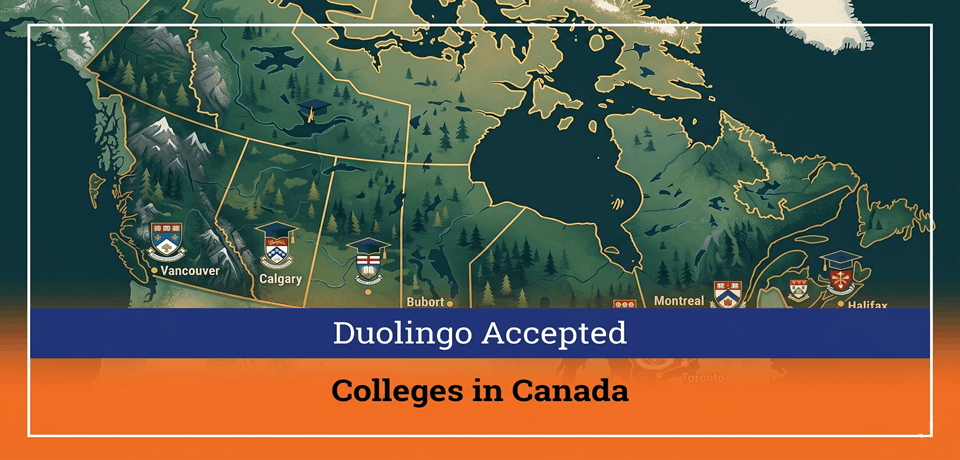
Duolingo accepted colleges in Canada
Many Canadian colleges accept the Duolingo English Test for diploma, certificate, postgraduate diploma and pathway programmes. College requirements are often different from universities, and each institution may set separate DET scores depending on the programme.
Many Canadian colleges publish DET requirements around the 95–110+ range, although some programmes may require higher scores. Students should confirm the requirement for their chosen course because health, technology and professional programmes may have stricter English standards.
| College or institution |
Province |
Typical DET range |
Notes |
| Algonquin College |
Ontario |
95–105 |
Programme-specific requirements apply |
| Sheridan College |
Ontario |
95–105 |
Popular for design, animation, media and business |
| Fanshawe College |
Ontario |
95–105 |
Check the exact programme page |
| Fleming College |
Ontario |
95–105 |
Requirements may vary by campus |
| British Columbia Institute of Technology |
British Columbia |
100–110 |
Technical programmes may be stricter |
| LaSalle College Montréal |
Québec |
Programme-specific |
Check the current admissions page |
| CDI College |
Multiple provinces |
Programme-specific |
Requirements vary by campus |
| Trebas Institute Montréal |
Québec |
Programme-specific |
Confirm before applying |
| Montreal Career College |
Québec |
Programme-specific |
Verify whether DET is accepted for the exact programme |
| Montreal Vocational College |
Québec |
Programme-specific |
Low-score claims should be checked directly |
Private and vocational college requirements can change quickly. If a college claims to accept a lower DET score, ask admissions to confirm it in writing before paying any application or deposit fee.
For wider Canada planning, you may also find BHE UNI’s study in Canada page useful.
Duolingo vs IELTS vs TOEFL for Canadian universities
Canadian universities generally accept multiple English proficiency tests, including the Duolingo English Test (DET), IELTS Academic and TOEFL iBT. The best option depends on your target university, programme requirements, application timeline and future plans.
|
Feature
|
Duolingo English Test
|
IELTS Academic
|
TOEFL iBT
|
|
Format
|
Online adaptive test
|
Test centre or computer-based
|
Test centre or online option (availability varies)
|
|
Test duration
|
About 1 hour
|
Around 2 hours 45 minutes
|
Around 2 hours
|
|
Score scale
|
10–160
|
Band score 0–9
|
Score scale 0–120
|
|
Result speed
|
Usually faster
|
Usually available within days
|
Usually available within days
|
|
Main advantage
|
Flexible online testing and quick results
|
Widely recognised globally
|
Strong academic focus and global recognition
|
|
Main limitation
|
Not accepted by every institution or programme
|
Requires scheduled test locations in many cases
|
Availability and cost may vary
|
Duolingo, IELTS and TOEFL scores cannot be compared perfectly because each test measures English ability differently. A DET score that meets one university’s requirement may not meet another institution’s requirement.
Students should always follow the English language requirement published by their chosen university and programme.
If you are still deciding between tests, compare BHE UNI’s pages on IELTS, TOEFL, PTE and Duolingo. Applicants who want to avoid IELTS should also check the guide on universities in Canada without IELTS.
Duolingo test for Canada study permit
Duolingo is primarily an English proficiency test for academic admission. It helps students meet the English language requirement of a Canadian university or college if their chosen institution accepts the Duolingo English Test (DET).
For a Canada study permit, Immigration, Refugees and Citizenship Canada (IRCC) evaluates the complete application, including the Letter of Acceptance from a Designated Learning Institution (DLI), financial documents, identity documents and other supporting information.
A Duolingo score supports the admission process, but it does not guarantee study permit approval. Students must meet all current IRCC study permit requirements and provide the necessary documents for their application.
Canada ended the Student Direct Stream (SDS) on 8 November 2024. Applicants who previously used SDS now apply through the regular study permit process.
This is important because some older guides may still mention SDS-specific requirements that no longer apply. For students planning to study in Canada, the key question is:
Does my chosen Canadian university or college accept Duolingo for my programme and provide a valid Letter of Acceptance?
If yes, DET can support your admission pathway. However, the study permit decision depends on the complete application, not only the English test score.
Is Duolingo accepted in Canada for PR?
No. The Duolingo English Test is not an approved language test for Canadian permanent residence applications.
For immigration pathways such as permanent residence, applicants must submit results from an IRCC-approved language test, including options such as IELTS General Training, CELPIP General, PTE Core or an approved French language test. This requirement is different from the English test used for university admission.
Duolingo can help students meet the English language requirement of a Canadian university or college when the institution accepts DET, but it does not replace an immigration-approved language test for PR purposes.
Students who plan to stay in Canada after graduation should also understand how their study pathway connects with future immigration options. You can explore our guides on post-graduation pathways in Canada and choosing courses that may support future Canadian career goals.
How to check whether a Canadian university accepts Duolingo
Do not rely only on third-party lists or old screenshots when checking Duolingo acceptance. English language requirements can change between admission cycles, and some Canadian universities may accept the Duolingo English Test only for specific programmes, study levels or faculties.
Use this process before applying:
- Visit the university’s official website and open the English language requirement or admission page.
- Search for “Duolingo English Test”, “DET” or “English proficiency requirements”.
- Check the minimum overall Duolingo score required.
- Check whether the university requires minimum DET subscores.
- Confirm whether DET is accepted for your study level (undergraduate, graduate or pathway).
- Open your exact programme page and verify the requirement again.
- Check the application deadline and test result validity period.
- Contact the admissions office if any information is unclear.
When contacting admissions, include your intended programme, study level, application intake, current DET score and any relevant academic details. Ask whether Duolingo is accepted for direct admission and whether any minimum subscore requirement applies.
A written confirmation from the university is more reliable than an outdated article, screenshot or unofficial admission list.
How to send Duolingo scores to Canadian universities
After receiving your Duolingo English Test result, you can send your score electronically from your Duolingo account to universities and colleges that accept the test.
Before sending your DET score, confirm the following:
- Your chosen university accepts the Duolingo English Test
- Your specific programme accepts DET
- Your overall score meets the required minimum
- Any required DET subscores are satisfied
- Your personal information matches your passport and application documents
- Your test result is within the accepted validity period
- Your score is submitted before the application deadline
Most institutions consider English proficiency test results valid for around two years, but validity rules can vary between universities and programmes. Always confirm the latest requirement on the official institution website before submitting your application.
Should you choose Duolingo, IELTS or TOEFL for Canada?
The right English test depends on your target university, programme requirements, application timeline and future plans. Duolingo, IELTS Academic and TOEFL iBT are all accepted by many institutions, but acceptance policies vary between universities and programmes.
Choose the Duolingo English Test if your target institutions clearly accept DET and you prefer a flexible online test option with faster results. It can be useful when IELTS or TOEFL test centres are difficult to access, more expensive, or unavailable before your application deadline.
Choose IELTS Academic or TOEFL iBT if:
- Your preferred university or programme does not accept Duolingo
- Your course specifically requires IELTS or TOEFL
- You are applying to multiple countries and want wider global recognition
- You may need an immigration-approved English test in the future
- You are applying for professional, regulated or highly competitive programmes
Some applicants use a mixed strategy. They take the Duolingo English Test first because of its flexibility and faster results, then take IELTS or TOEFL later if a specific university, scholarship opportunity or immigration pathway requires another test.
This approach can work well, but students should plan their test dates carefully and confirm requirements before paying for any additional exam.
How to prepare for the Duolingo English Test
The Duolingo English Test is shorter than IELTS or TOEFL, but it still requires proper preparation. Because DET is an adaptive test with fast-paced questions, students should understand the format and practise regularly before taking the exam.
Learn the test format first
Before focusing on grammar and vocabulary, understand how the Duolingo English Test works. The test includes different question types that evaluate reading, writing, listening and speaking skills.
You may need to:
- identify real English words
- listen and type what you hear
- complete missing letters or words
- describe images
- answer spoken questions
- write short responses
- speak about a given topic
Many students lose marks because they are unfamiliar with the test format and time pressure, not necessarily because their English ability is weak.
Build academic English skills
Canadian universities expect students to communicate effectively in lectures, assignments, presentations and academic discussions. Your preparation should focus on practical English skills rather than memorising answers.
To improve:
- Read short academic articles and online news
- Listen to English podcasts, lectures and interviews
- Practise explaining your opinions clearly
- Write short paragraphs with a clear structure
- Learn useful academic vocabulary
Avoid depending only on memorised templates because DET evaluates natural language ability.
Practise speaking clearly
Speaking is one of the most challenging parts for many applicants because they need to answer quickly while recording themselves.
Practise speaking for 10–15 minutes every day. Record your answers and review:
- unnecessary pauses
- repeated words
- unclear pronunciation
- grammar mistakes
- lack of structure
Practise answering common questions such as:
- Why do you want to study abroad?
- Why did you choose your subject?
- Describe a challenge you solved.
- Do you prefer online learning or classroom learning?
Regular speaking practice helps you become more confident and organised.
Improve short writing skills
Duolingo writing tasks are shorter than traditional IELTS or TOEFL essays, but clear communication is still important.
Practise writing short responses on topics such as:
- education
- technology
- travel
- work
- culture
- student life
After writing, check:
- Is my answer easy to understand?
- Are my sentences grammatically correct?
- Did I explain my main idea clearly?
Focus on clarity and accuracy instead of using complicated vocabulary.
A simple 30-day Duolingo study plan
If your English level is already around intermediate level, a focused 30-day preparation plan can help you become familiar with the test format and improve weak areas.
|
Days
|
Focus
|
|
1–3
|
Understand DET format and complete a practice test
|
|
4–10
|
Improve reading, listening and vocabulary skills
|
|
11–17
|
Practise speaking and writing responses under time limits
|
|
18–23
|
Take mock tests and analyse mistakes
|
|
24–27
|
Focus on weak question types and improve accuracy
|
|
28–29
|
Prepare ID, test environment and technical setup
|
|
30
|
Take the test confidently
|
If your English level is below an intermediate level, give yourself additional preparation time. Rushing the test may lead to lower scores, retakes and missed application deadlines.
Common mistakes to avoid
Assuming every Canadian university and programme accepts Duolingo
Many do, but not all. Even where DET is accepted, some programmes may require IELTS, TOEFL or higher scores.
Looking only at the overall score
Some universities require both an overall score and minimum subscores. A 120 overall score may still be a problem if one subscore is too low.
Confusing admission with immigration
Duolingo can help with university or college admission. It is not the same as an IRCC-approved language test for PR.
Trusting outdated immigration information
Immigration policies can change. Students should always follow the latest IRCC guidance instead of relying on old SDS-related information or outdated articles.
Applying with the lowest possible score
A low score may open some routes, but it can limit your choices. If you are aiming for stronger universities, competitive programmes or scholarships in Canada, a higher English score is usually worth the effort.

Frequently asked questions
Is Duolingo accepted in Canada in 2027?
Yes, many Canadian universities and colleges accept the Duolingo English Test for academic admission. However, acceptance and score requirements depend on the institution, programme and study level.
Does Canada accept Duolingo English Test?
Many Canadian institutions accept the Duolingo English Test for admission. However, Duolingo is not used as a general immigration language test for PR.
What is the minimum Duolingo score for Canada?
The minimum Duolingo score for Canada is usually between 105 and 125 for universities. Some colleges and pathway programmes may accept scores around 95–105, while competitive programmes may require 120 or higher.
Is 105 Duolingo accepted in Canada?
A 105 DET score may be accepted by some Canadian colleges, pathway programmes and selected universities. However, it may not be sufficient for competitive programmes or many graduate courses.
Which Canadian universities accept Duolingo English Test?
Canadian universities accepting Duolingo English Test include many well-known institutions, such as University of Alberta, University of Calgary, York University, Simon Fraser University, Concordia University, University of Manitoba, University of Saskatchewan, University of Guelph, Carleton University and others. Exact requirements vary by programme.
Is Duolingo accepted for master’s in Canada?
Yes, some Canadian universities accept Duolingo for master’s programmes. Graduate requirements are usually stricter, and many applicants should target 120–125 or higher.
Is Duolingo accepted for Canada study permit?
Duolingo can support admission if your chosen Canadian institution accepts DET. However, study permit approval depends on meeting all IRCC requirements, not only your English test score.
Is Duolingo accepted in Canada for PR?
No. Duolingo is not normally accepted for Canadian PR language proof. PR applicants usually need an IRCC-approved immigration language test.
Can I study in Canada without IELTS using Duolingo?
Yes, some Canadian universities and colleges allow students to apply without IELTS if they accept the Duolingo English Test for that programme.
Do Duolingo accepted colleges in Canada have lower score requirements?
Some colleges and pathway providers may have lower DET requirements than universities. Scores around 95–110 are common in many college contexts, but each institution sets its own rule.
Can Duolingo help with Canada study plans?
Yes, Duolingo can help students who are applying to Canadian universities and colleges that accept DET. However, students should plan their English test choice based on their complete study pathway, including admission requirements, future career plans and possible immigration goals.
Can I apply to Canada universities with Duolingo?
Yes, you can apply to Canadian universities with Duolingo if your chosen institution and programme accept the test. Always verify the current English language requirement before submitting your application.
Conclusion
Duolingo accepted universities in Canada provide international students with a flexible option to meet English language requirements for academic admission. The Duolingo English Test is recognised by many Canadian universities and colleges and is often listed alongside IELTS, TOEFL and other accepted English proficiency tests.
The best approach is to choose your programme first and then select the English test that matches the institution’s requirement. Before applying, check whether your chosen university and programme accept the Duolingo English Test, review the required score and confirm whether any subscore requirements apply.
For many undergraduate applicants, a DET score around 110–115 may meet the requirements of some institutions, while competitive universities, graduate programmes and professional courses may require stronger scores such as 120–125 or higher.
Duolingo can simplify the admission process, but students should use it strategically. Always check official university requirements, keep immigration rules separate from admission requirements, avoid outdated visa information, and explore broader Canada study options for international students before making your final decision.