Public Universities in Australia are often the first choice for international students who want globally recognised degrees, strong academic standards, wide course options and a clear route from admission to visa planning.
Australia has 42 universities in total, including 36 public universities and 6 private universities. For most students, the public system offers the strongest mix of reputation, research, course variety and graduate value.
The short answer is simple: if you want an internationally recognised degree with strong career value, a public university in Australia should usually be on your shortlist. If you are still comparing cities, intakes or course types, it helps to understand the wider process of studying in Australia before choosing a university.
Quick Summary
|
Question
|
Short answer
|
|
How many universities are in Australia?
|
42 universities
|
|
How many public universities are in Australia?
|
36 public universities
|
|
Best public universities by ranking
|
UNSW Sydney, University of Melbourne, University of Sydney, ANU, Monash University and the University of Queensland
|
|
Average tuition fees for international students
|
Around AUD 20,000–45,000 per year for bachelor’s degrees and AUD 22,000–50,000 for master’s degrees
|
|
Best for international students
|
Universities with the right course, entry requirements, fees, scholarships and city fit
|
How Many Public Universities Are in Australia?
There are 36 public universities across Australia. The country has 42 universities in total, made up of 36 public and 6 private universities, according to the official Study Australia university list.
Public universities are mainly government-supported institutions. That does not mean they are free for international students. It means they operate within Australia’s public higher education system and usually have wider course availability, stronger research activity and greater global visibility than most private providers.
Here’s the thing many students miss: not every public university is a Group of Eight university. The Group of Eight is a smaller group of research-intensive universities, not a label for all government universities in Australia. Go8 universities often rank highly, but several non-Go8 public universities are excellent for practical learning, industry links, nursing, IT, business, education and regional study options.

List of Public Universities in Australia 2026
Below is a compact list of Australia’s public university system. Course availability, campuses, fees and entry requirements can change by intake, so always check the course page before applying.
|
Public university
|
Main location
|
Strong areas to check first
|
|
Adelaide University
|
Adelaide, South Australia
|
Research, health, engineering, business
|
|
Australian Catholic University
|
Sydney, Melbourne, Brisbane, Canberra
|
Nursing, education, health, social sciences
|
|
Australian National University
|
Canberra, ACT
|
Politics, economics, science, research
|
|
Charles Darwin University
|
Darwin, Northern Territory
|
Nursing, education, environmental studies
|
|
Charles Sturt University
|
Regional NSW and ACT
|
Education, agriculture, policing, health
|
|
CQUniversity Australia
|
Queensland and multi-city campuses
|
Nursing, business, IT, engineering
|
|
Curtin University
|
Perth, Western Australia
|
Engineering, business, health, mining
|
|
Deakin University
|
Victoria
|
Business, IT, health, education
|
|
Edith Cowan University
|
Perth, Western Australia
|
Cyber security, nursing, business
|
|
Federation University Australia
|
Victoria
|
Business, IT, engineering, health
|
|
Flinders University
|
Adelaide, South Australia
|
Medicine, nursing, science, education
|
|
Griffith University
|
Brisbane and Gold Coast, Queensland
|
Hospitality, business, health, environment
|
|
James Cook University
|
Queensland
|
Marine science, medicine, tropical health
|
|
La Trobe University
|
Victoria
|
Health, science, humanities, business
|
|
Macquarie University
|
Sydney, NSW
|
Business, finance, IT, linguistics
|
|
Monash University
|
Melbourne, Victoria
|
Medicine, pharmacy, engineering, business
|
|
Murdoch University
|
Perth, Western Australia
|
Veterinary science, environment, business
|
|
Queensland University of Technology
|
Brisbane, Queensland
|
Business, IT, media, design
|
|
RMIT University
|
Melbourne, Victoria
|
Design, engineering, business, technology
|
|
Southern Cross University
|
NSW and Queensland
|
Health, tourism, environmental science
|
|
Swinburne University of Technology
|
Melbourne, Victoria
|
Technology, design, business
|
|
University of Canberra
|
Canberra, ACT
|
Sports science, health, public policy
|
|
University of Melbourne
|
Melbourne, Victoria
|
Medicine, law, business, research
|
|
University of New England
|
Armidale, NSW
|
Agriculture, education, health
|
|
University of New South Wales
|
Sydney, NSW
|
Engineering, business, law, technology
|
|
University of Newcastle
|
Newcastle, NSW
|
Engineering, medicine, education
|
|
University of Queensland
|
Brisbane, Queensland
|
Science, health, agriculture, business
|
|
University of Southern Queensland
|
Toowoomba, Queensland
|
Engineering, aviation, education, IT
|
|
University of Sydney
|
Sydney, NSW
|
Medicine, law, business, arts
|
|
University of Tasmania
|
Hobart, Tasmania
|
Marine studies, health, environment
|
|
University of Technology Sydney
|
Sydney, NSW
|
IT, business, design, engineering
|
|
University of the Sunshine Coast
|
Queensland
|
Health, education, business
|
|
University of Western Australia
|
Perth, Western Australia
|
Science, medicine, engineering
|
|
University of Wollongong
|
Wollongong, NSW
|
Engineering, IT, business, health
|
|
Victoria University
|
Melbourne, Victoria
|
Sport, business, health, education
|
|
Western Sydney University
|
Sydney, NSW
|
Nursing, education, business, social sciences
|
If your goal is affordability, compare regional campuses and lower-cost Australian course options, not only headline ranking.
Top Public Universities in Australia by Ranking
Rankings help when comparing the best public universities in Australia, but they should not make the whole decision for you. QS and Times Higher Education use different methods, so the order can change. In the latest QS World University Rankings 2027, UNSW Sydney leads Australia; in Times Higher Education 2026, the University of Melbourne remains Australia’s top-ranked university.
|
University
|
QS 2027 world rank
|
THE 2026 world rank
|
Best known for
|
|
UNSW Sydney
|
19
|
79
|
Engineering, business, employability
|
|
University of Melbourne
|
=22
|
37
|
Research, medicine, law, business
|
|
University of Sydney
|
28
|
=53
|
Medicine, law, arts, global reputation
|
|
Australian National University
|
29
|
=73
|
Policy, economics, science, research
|
|
Monash University
|
31
|
=58
|
Pharmacy, medicine, engineering, business
|
|
University of Queensland
|
=40
|
=80
|
Science, agriculture, health, research
|
|
University of Western Australia
|
=77
|
153
|
Science, engineering, medicine
|
|
Adelaide University
|
79
|
133
|
Research, health, engineering
|
|
University of Technology Sydney
|
=87
|
=145
|
Technology, design, business
|
|
RMIT University
|
=119
|
251–300
|
Design, technology, business
|
A mildly surprising point: the “best” university can change depending on the ranking table. For students, course fit often matters more than a difference of 20 or 30 places in a global ranking.
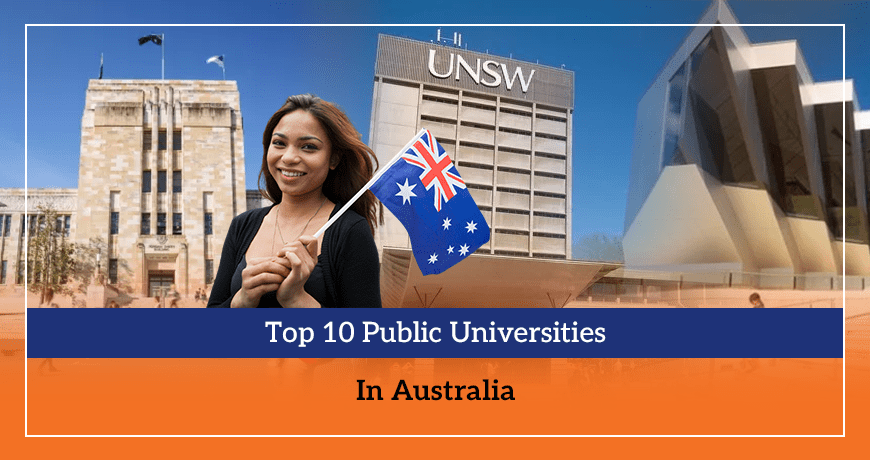
Top 10 Public Universities in Australia
1. UNSW Sydney
UNSW Sydney is one of the strongest Australian public universities for engineering, business, law, technology and career-focused education. It ranks 19th globally in QS 2027 and sits in one of Australia’s largest student and employment markets. Indicative tuition for international students often falls around AUD 43,000–62,000 per year, depending on the course. It suits students who want industry links and a competitive graduate profile.
2. University of Melbourne
The University of Melbourne has long been one of Australia’s most recognised universities. It performs especially well in research, medicine, law, business and the arts. Tuition commonly sits around AUD 37,000–60,000 per year, with some health and professional programmes costing more. If you want a research-heavy environment in a major city, Melbourne deserves serious attention.
3. University of Sydney
The University of Sydney combines historic reputation with strong global rankings and a broad course catalogue. It is a strong choice for medicine, law, business, engineering and humanities. International tuition is often around AUD 46,000–60,000 per year, depending on the degree. It works well for students who want a central Sydney location and a large international community.
4. Australian National University
ANU is based in Canberra and has a strong reputation for politics, economics, international relations, science and research. It is a good fit for students who want a quieter capital-city environment rather than a huge commercial city. Annual tuition often ranges from about AUD 39,000–54,000, depending on the course. ANU is particularly attractive for postgraduate and research-focused students.
5. Monash University
Monash is one of Australia’s largest and most internationally active public universities. It is especially strong in pharmacy, medicine, engineering, business and science. Fees often sit around AUD 39,000–58,000 per year. Monash suits students who want a large university system, strong research, multiple campuses and wide course choice.
6. University of Queensland
The University of Queensland is based in Brisbane and is strong in science, health, agriculture, business and engineering. It offers a balance of global ranking, research quality and a slightly different lifestyle from Sydney or Melbourne. Indicative international tuition usually falls around AUD 42,000–56,000 per year. UQ is worth shortlisting if you want a leading university in a warmer city.
7. University of Western Australia
UWA is based in Perth and performs well in science, engineering, medicine and environmental subjects. It is a Group of Eight member and offers a strong research environment with access to Western Australia’s industries. Tuition can range from around AUD 35,000–55,000 per year. Perth may also appeal to students who want a major city without the same pace as Sydney or Melbourne.
8. Adelaide University
Adelaide University is a major South Australian public university formed through the merger of the University of Adelaide and the University of South Australia. It is already visible in global ranking tables and has strengths in health, engineering, business and research. Tuition may commonly sit around AUD 39,000–52,000 per year. Check course pages carefully during the transition period, as programme structures may evolve.
9. University of Technology Sydney
UTS is a modern public university in central Sydney, known for technology, design, engineering, communication and business. It is a practical choice for students who prefer applied learning and industry-connected courses. Indicative annual tuition often ranges around AUD 38,000–54,000. Think about UTS if you want a city-based study experience with a strong focus on employability.
10. RMIT University
RMIT is based in Melbourne and has a strong reputation in design, technology, engineering, media and business. It is less traditional than some Go8 universities, but that can be a strength for students who want practical, career-focused learning. Tuition often ranges from around AUD 37,000 to 48,000 per year. RMIT is a smart option for creative, technical and industry-facing subjects.
Public vs Private Universities in Australia
Public universities usually dominate search results because they are larger, more established and more visible in global rankings. Private universities can still be useful for certain specialist courses, but most international students begin with Australian public universities because the course range is wider.
|
Factor
|
Public universities
|
Private universities
|
|
Funding model
|
Government-supported
|
Privately operated
|
|
Course range
|
Usually broad
|
Often narrower or specialist
|
|
Research activity
|
Usually stronger
|
Varies by institution
|
|
Global rankings
|
More visible
|
Less visible overall
|
|
Best for
|
Research, recognition, wider options
|
Niche or flexible study routes
|
If you are comparing public and private options, do it by course outcome, not name alone. A lower-ranked public university can still be the better choice if it offers the right location, placement structure, entry pathway or scholarship.
Tuition Fees, Scholarships and Intakes
International tuition fees vary by university, course and level of study. As a safe planning range, international undergraduate students should expect about AUD 20,000–45,000 per year, while master’s degrees often cost around AUD 22,000–50,000 per year. Medicine, veterinary science, dentistry, MBA and some engineering programmes can cost more.
Most public universities offer scholarships based on academic merit, course area or nationality. Availability changes by year, so compare official university pages alongside Australia scholarship options before you apply.
The main Australian university intakes are usually February/March and July. Some universities also offer November or trimester-based intakes. Apply early if your course is competitive, your documents need extra review, or your visa timeline is tight.
Admission Requirements for International Students
Admission requirements differ by course, but most public universities ask for academic transcripts, a valid passport, proof of English language ability and course-specific documents. Undergraduate applicants usually need secondary school qualifications. Postgraduate applicants normally need a relevant bachelor’s degree, and some programmes may ask for work experience, a portfolio or a research proposal.
For English language requirements, universities commonly accept IELTS, TOEFL or PTE Academic. The required score depends on the course. Nursing, teaching, law and health-related degrees often ask for higher scores than general business or IT programmes.
You may also need a Statement of Purpose, letters of recommendation and a CV for postgraduate applications. Once you accept an offer, the next steps usually involve Confirmation of Enrolment (CoE), Overseas Student Health Cover (OSHC) and the Student Visa Subclass 500. Students should also understand health cover while studying, because OSHC usually forms part of visa planning.
This is where many students lose time. They choose a university first, then discover that the course, English score or document timeline does not match their intake. A better approach is to check eligibility before falling in love with a campus photo.
If your documents, offer conditions or visa steps feel unclear, getting student-focused application guidance early can save several weeks. For visa-related steps after an offer, specialist visa support after admission can also help you avoid common timing mistakes.
How to Choose the Right Public University in Australia
Start with the course, not the ranking. If you want cyber security, nursing, accounting, engineering or public health, compare the actual modules, placement options, accreditation and graduate outcomes.
Next, check the city. Sydney and Melbourne offer huge networks, but they can be expensive. Brisbane, Perth, Adelaide, Canberra and regional cities may offer a different balance of cost, lifestyle and opportunity.
Then compare entry requirements. A university is not the right choice if your profile does not meet the academic or English requirement for that course. Think about it this way: the best shortlist is not the one with the most famous names; it is the one where your budget, eligibility, career goal and intake all line up.
If you are unsure, you can review your options with an adviser before submitting applications.

FAQs About Public Universities in Australia
How many public universities are in Australia?
Australia has 36 public universities out of 42 universities in total. The rest are private universities.
Are Australian public universities free for international students?
No. Public universities receive government support, but international students pay tuition fees. Fees vary by course and university.
What is the best public university in Australia?
It depends on the ranking system and the course. UNSW Sydney leads Australia in QS 2027, while the University of Melbourne leads the Times Higher Education Australia ranking for 2026.
Which public university in Australia is cheapest for international students?
There is no single cheapest university for every student. Fees depend on the course. Regional and non-Go8 universities often have more affordable options than highly ranked city-based universities.
Are government universities in Australia the same as public universities?
Students often use “government universities in Australia” to mean public universities. In practice, public universities are the main government-supported university institutions.
Can international students apply to Australian public universities?
Yes. Australian public universities accept international students across undergraduate, postgraduate and research programmes, provided students meet academic, English language and visa requirements.
What IELTS score is required for Australian public universities?
Many courses ask for around IELTS 6.0–6.5 overall, but health, teaching, law and some postgraduate courses may require higher scores. Universities may also accept TOEFL or PTE Academic.
Do Australian public universities offer scholarships?
Yes. Many public universities offer merit-based scholarships, research scholarships and course-specific awards. Availability changes by year, so check early.
What to Do Next
Public Universities in Australia remain a strong choice for international students because they combine global recognition, wide course choice, research quality and practical career opportunities.
Do not choose only by ranking. Choose by course fit, fees, entry requirements, scholarship options, city and long-term outcome. That is how you build a shortlist that actually works.