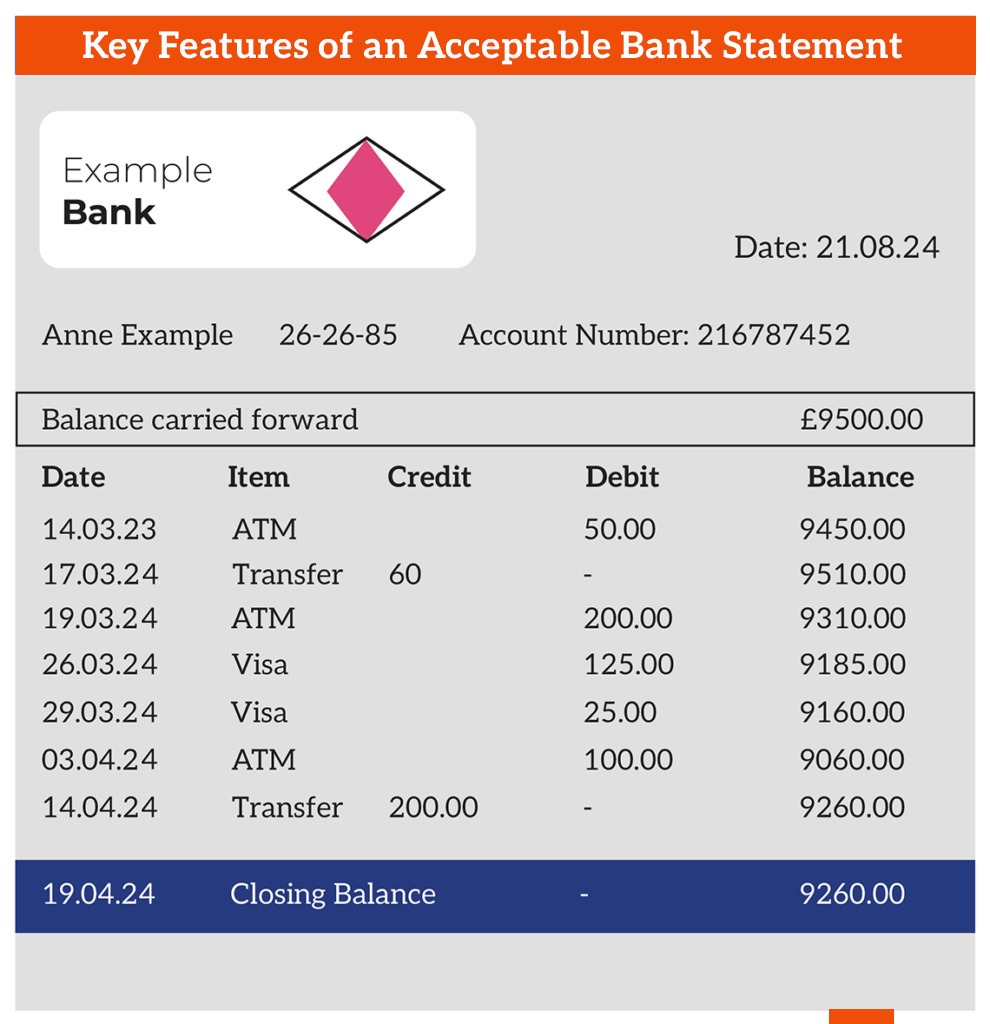
An acceptable bank statement for UK visa applications is a clear, complete and verifiable financial document that shows you have access to enough money for the visa route you are applying under. It should come from a regulated bank or financial institution, show your name or the account holder’s name, include the bank’s details, and clearly display the balance, dates and transaction history.
The exact UK visa bank statement requirement depends on the visa type. A Student visa is usually assessed against fixed financial rules, including the 28-day rule. A Standard Visitor visa is assessed more broadly: the decision maker wants to see that your trip is affordable, your funds are genuine, and your financial circumstances make sense.
This guide explains which bank statement is acceptable for UK visa applications, how many months’ bank statement may be needed, when online bank statements are acceptable, whether statements need to be stamped, how UKVI may verify bank statements, and what mistakes can lead to refusal.
Quick answer: What makes a bank statement acceptable for a UK visa?
A bank statement is usually acceptable for a UK visa if it clearly shows:
|
Requirement
|
Why it matters
|
|
Account holder’s name
|
It must be clear whose money is being used
|
|
Bank name or building society name
|
UKVI must be able to identify the financial institution
|
|
Account number or identifiable account details
|
Helps connect the statement to the account
|
|
Statement date or issue date
|
Shows whether the evidence is recent enough
|
|
Transaction history
|
Shows how the money entered and moved through the account
|
|
Current or closing balance
|
Shows whether enough money is available
|
|
Currency
|
Allows the funds to be assessed in pounds sterling if needed
|
|
Official bank format
|
Makes the document easier to verify
|
|
Complete pages
|
Prevents suspicion that information has been removed
|
|
Readable copy or digital file
|
The caseworker must be able to check it without difficulty
|
For UK Student visa financial evidence, GOV.UK says bank statements can be paper statements or electronic downloads, and other accepted evidence may include building society passbooks, certificates of deposit, or letters from a bank or building society. The evidence must show your name, the bank or building society name and how much money is in the account.
A bank statement becomes weak or risky when it is incomplete, difficult to verify, too old, inconsistent with the rest of the application, or full of large unexplained deposits.
Bank statement requirements by UK visa type
The same bank statement may not work in the same way for every UK visa. Before preparing your financial evidence, check which route applies to you.
|
Visa type
|
What the bank statement must mainly prove
|
|
UK Student visa
|
You have enough money for unpaid course fees and living costs, and the required funds have been held for the correct period
|
|
Child Student visa
|
You or your parent/guardian can meet the relevant fees and living cost requirements
|
|
UK Standard Visitor visa
|
You can afford your visit, support yourself and any dependants, and pay for your return or onward journey
|
|
Sponsored visitor application
|
Your sponsor can genuinely provide travel, maintenance or accommodation support
|
|
Sponsored or endorsed work routes
|
You meet the maintenance requirement, unless your sponsor or endorsing body confirms support
|
|
Applications using parent or partner funds
|
The account holder controls the funds and the relationship/support arrangement is properly evidenced
|
This is where many applicants make mistakes. They search for “how many months bank statement for UK visa” and expect one universal answer. In reality, the correct answer depends on the route. A Student visa has a specific 28-day funds rule. A visit visa does not have the same fixed maintenance calculation, but your bank statement still needs to make your trip look financially credible.
UK Student visa bank statement requirements
For a UK Student visa, your bank statement must show that you have enough money to pay for:
- your course fees, as shown on your Confirmation of Acceptance for Studies, known as CAS
- your living costs
- your partner or children’s living costs, if they are applying as dependants
For courses other than boarding at a residential independent school, the current Student visa living cost requirement is £1,171 per month outside London and £1,529 per month in London, up to a maximum of 9 months. Dependants need £680 per month outside London or £845 per month in London, also up to a maximum of 9 months.
A simple way to calculate the student visa amount is:
Unpaid course fees shown on your CAS + required living costs = minimum funds you need to show
For example, if your CAS shows £8,000 in unpaid tuition fees and you will study in London for a course lasting 9 months or more, you would usually calculate:
£8,000 + £13,761 = £21,761
The £13,761 figure comes from £1,529 × 9 months.
If you are studying outside London for 9 months or more, the living cost part would usually be:
£1,171 × 9 = £10,539
Always check the latest GOV.UK guidance before applying, because financial figures can change.
The 28-day rule for UK visa bank statements
The 28-day rule is one of the most important parts of UK Student visa financial evidence. GOV.UK says you must have had enough money for 28 days in a row, calculated by counting back from the date of the closing balance on the most recent evidence you provide.
This means your balance should not fall below the required amount at any point during that 28-day period.
For example, if you need to show £21,761, your account should show at least that amount every day throughout the required 28-day period. If the balance drops below the required amount even once, the statement may not meet the rule.
A good bank statement for visa application purposes does not just show a high final balance. It shows that the required money has been held consistently.
The 31-day rule: how recent must the bank statement be?
GOV.UK specifies that the financial proof for a student visa must be from no more than 31 days before you apply.
This is often called the "31-day rule." This means that the date you apply for your visa online should be close to the date when your balance is due or when you have to show proof.
A common mistake is collecting the bank statement too early. The funds may have been held correctly, but if the statement is too old by the time you submit the application, it can create a problem.
For sponsored or endorsed work routes where applicants must show funds, GOV.UK also says the funds must usually have been held for 28 days and the bank statement or evidence must be from the 31 days before the application.
How many months bank statement is required for UK visa?
There is no single answer for every UK visa.
The 28-day rule, not the overall 6-month statement rule, is frequently the most important thing you need to get a UK student visa. The bank evidence must also be recent enough under the 31-day rule.
For a UK Standard Visitor visa, applicants commonly provide recent bank statements covering several months, often up to 6 months, because the decision maker wants to understand income, spending habits, savings pattern and affordability. GOV.UK’s visitor supporting document guidance says applicants may provide financial documents showing sufficient funds, such as bank statements that detail the origin of the funds held, building society books, and proof of earnings.
So, if you are asking “how many months bank statement for UK visa?”, the better question is:
Which UK visa route am I applying for, and what does my financial evidence need to prove?
For visitors, a lengthier transaction history can help prove that they have a steady income and real savings. The minimal balance and timeliness are more set by rules for students.
UK Visitor visa bank statement requirements
For a UK Standard Visitor visa, the bank statement is not judged only by the final balance. It is part of a wider credibility assessment.
GOV.UK says visitors need to show they are genuine visitors, will leave the UK at the end of the visit, can support themselves and any dependants during the trip, and can pay for the return or onward journey and other costs relating to the visit.
A strong UK visitor visa bank statement should usually show:
- regular income or a clear source of funds
- enough money to cover travel, accommodation, daily expenses and return travel
- spending that makes sense for your income level
- no sudden unexplained deposits
- no pattern suggesting that money was placed in the account only to support the visa application
- consistency with your employment, business, sponsor or family situation
There is no official fixed minimum bank balance for a Standard Visitor visa. A short, modest trip may require much less money than a long visit with hotel stays in expensive cities. The statement should make the planned visit look affordable in relation to your normal financial life.
If your trip costs most of your savings, or if your account suddenly receives a large amount shortly before applying, the decision maker may question whether the funds are genuinely available for your use.
What should a UK visa bank statement show?
A good bank statement for UK visa application purposes should be easy to understand. A caseworker should not have to guess what the document is, whose account it is, or whether the funds are available.
Ideally, the statement should show:
- your full name, or the full name of the account holder
- account number or identifiable account reference
- bank or building society name
- bank logo, letterhead or official digital format
- statement period
- issue date or closing balance date
- full transaction history for the relevant period
- closing balance
- currency
- all pages in order
- no editing, cropping or hidden information
If the statement is not in English or Welsh, visitor guidance from GOV.UK says documents should be accompanied by a full translation that can be independently verified by the Home Office. The translation should include confirmation of accuracy, the date, the translator’s full name and signature, and contact details.
Is online bank statement acceptable for UK visa?
Yes, an online bank statement can be used to get a UK visa as long as it has the right information and is explicitly issued or can be downloaded from the bank.
For Student visa financial evidence, GOV.UK says bank statements can be paper or electronic downloads.
For sponsored or endorsed work routes, GOV.UK is even clearer: electronic bank statement downloads can be provided if they show the required information, and they do not need to be stamped by the bank.
Not every screenshot is a good online statement, though. A screenshot from a banking app might not show important information like your full name, account number, bank name, statement period, or full transaction history. A PDF statement that you download is usually better than a cropped screenshot.
A good electronic statement should be:
- downloaded from online banking or the banking app
- complete, not cropped
- readable
- dated
- clearly linked to the account holder
- consistent with the other documents in the application
Do bank statements need to be stamped for UK visa?
In many cases, official electronic bank statements do not need to be stamped if they already contain the required details and can be verified. GOV.UK’s work-route financial evidence guidance says electronic bank statement downloads do not need to be stamped by the bank when they include the required information.
However, a stamped bank statement for visa purposes may still be useful if:
- the printed statement does not look official
- the statement lacks a bank logo or letterhead
- the local bank’s PDF format is basic or unclear
- the visa centre or adviser specifically recommends certification
- you are using a bank letter instead of full statements
- the account is from a smaller or less familiar financial institution
If you are unsure, ask the bank for a statement on official stationery or request a stamped and signed copy. It is better to submit a slightly more formal document than a weak one that creates avoidable doubt.
Can I use a bank certificate instead of a bank statement?
A bank certificate or bank letter can sometimes support a visa application, but it does not always replace a full bank statement.
For Student visa financial evidence, GOV.UK lists letters from a bank or building society as one possible type of evidence. The evidence must still show the required information, including your name, the bank or building society name and how much money is in the account.
A useful bank certificate should normally include:
- account holder’s name
- account number or reference
- account type
- current balance
- currency
- date of issue
- bank name and contact details
- confirmation that the account is active
- bank stamp or authorised signature, if issued in paper form
For Student visa applications, the certificate or letter must still support the 28-day rule if that rule applies. A letter showing only today’s balance may not be enough if it does not prove the funds were held for the required period.
If you are wondering where to address a bank certificate for UK visa, it is usually safest to address it generally to UK Visas and Immigration or To Whom It May Concern, unless your bank or adviser gives route-specific wording.
Can I use someone else’s bank statement for a UK visa?
Sometimes, yes. But it depends on the visa route and the relationship between you and the account holder.
Parent or legal guardian’s bank statement
For a UK Student visa, you may be able to rely on your parent’s money. GOV.UK says parent’s money can be used, but the parent must provide a letter confirming they agree to you using it this way.
You should usually provide:
- parent or legal guardian’s bank statement
- consent letter confirming you can use the funds
- proof of relationship, such as a birth certificate, adoption certificate or legal guardianship document
- translation if the relationship document is not in English or Welsh
The name on the relationship document should match the names used in the application. If there has been a name change, include supporting evidence.
Partner’s bank statement
For some routes, a partner’s money can be used if the partner is in the UK or applying at the same time. GOV.UK includes partner’s money as an accepted source for Student visa financial evidence in that situation.
You should be prepared to show the relationship and explain why those funds are available to you.
Sponsor’s bank statement for a UK Visitor visa
For a Standard Visitor visa, someone else can help pay for your travel, maintenance or accommodation. GOV.UK says that if a sponsor is supporting you, you should provide evidence showing what support is being provided, how it is being provided, whether the sponsor has enough funds, the relationship between you and the sponsor, and the sponsor’s legal status in the UK if applicable.
A sponsor pack may include:
- sponsor letter
- sponsor bank statements
- sponsor payslips or proof of income
- proof of relationship
- copy of sponsor’s passport or UK residence document, if relevant
- accommodation evidence, if the sponsor is hosting you
- explanation of which costs the sponsor will cover
A sponsor’s bank statement is not a shortcut. The sponsor must be financially credible too. If the sponsor’s own income is low, their account is unstable, or their support is not clearly explained, the application may still look weak.
Joint account
A joint account may be acceptable if your name is on the account and you can show access to the funds. If the other account holder is funding your trip or studies, explain the relationship clearly and include supporting documents where needed.
Can I use fixed deposits, savings accounts or certificates of deposit?
Savings accounts and current accounts are commonly used because they normally show accessible funds and transaction history. Fixed deposits or certificates of deposit may also be accepted in some circumstances, especially where they prove that the money is available to you and can be accessed when needed.
For Student visa evidence, GOV.UK lists certificates of deposit as one possible form of evidence.
Be careful with any account or product that restricts access. If the money is locked, not immediately accessible, or cannot be used for your costs in the UK, it may not be persuasive.
For visitor applications, fixed deposits may support the financial picture, but they are usually stronger when combined with regular bank statements showing income and everyday financial activity.
Foreign currency bank statements
Your bank statement does not need to be in pounds sterling. Many applicants apply with statements in local currency.
For Student visa financial evidence, GOV.UK says foreign currency is converted into British pounds using the OANDA spot exchange rate for the date of the application.
This matters because exchange rates move. If your balance is only just above the required amount, a small currency change could create risk. It is sensible to keep a buffer rather than holding the exact minimum.
For example, if the required amount is £21,761, do not aim to hold the exact equivalent in your local currency. Keep extra funds where possible so the balance remains safely above the requirement after conversion.
Source of funds: why your transaction history matters
A bank statement does more than show a balance. It tells a financial story.
Decision makers may look at where the money came from, how long it has been there, whether the pattern matches your declared income, and whether the funds appear genuinely available.
A strong statement usually has a clear source of funds, such as:
|
Source of funds
|
Helpful supporting evidence
|
|
Salary
|
Payslips, employment letter, tax documents
|
|
Business income
|
Business registration, invoices, tax returns, business bank statements
|
|
Savings
|
Regular income deposits and consistent saving pattern
|
|
Scholarship
|
Official scholarship or sponsorship letter
|
|
Family gift
|
Gift letter, donor bank statement, relationship evidence
|
|
Property sale
|
Sale agreement, completion statement or transfer evidence
|
|
Loan
|
Loan approval letter, repayment terms and disbursement evidence
|
|
Pension or retirement income
|
Pension statement, where relevant to the visa route
|
Not every deposit needs a long explanation. But large, recent or unusual credits should be easy to understand. If the money entered the account suddenly, include documents that explain it.
Funds parking and sudden deposits
“Funds parking” means placing money into an account temporarily to make the balance look stronger for the visa application. UKVI may be concerned if a large amount appears shortly before the application and there is no clear explanation.
A sudden deposit is not automatically a problem. It becomes a problem when it looks artificial, borrowed for appearance, or inconsistent with your normal finances.
Examples of deposits that may need explanation include:
- a large cash deposit
- money transferred from a relative shortly before applying
- a business payment that is not supported by invoices
- proceeds from a property or asset sale without evidence
- a loan paid into the account without loan documents, even where the money comes from legitimate education loan options for studying abroad
- funds moved between multiple accounts with no explanation
If the deposit is genuine, explain it calmly and support it with documents. A short cover letter can help connect the bank statement to the evidence, especially for visitor applications.
Does UKVI verify bank statements?
UKVI may verify bank statements and other financial evidence. GOV.UK says evidence may be checked with the bank, and if the evidence cannot be verified, the application may be refused.
This is why the statement should be genuine, complete and easy to verify.
Applicants often ask, “How does UKVI verify bank statements?” The exact checks can vary, and UKVI does not publish every verification method. In practice, a caseworker may assess whether the document appears authentic, whether the transactions make sense, whether the account and bank details are verifiable, and whether the financial evidence is consistent with the application.
Do not edit a bank statement. Do not remove pages. Do not change balances, dates, names or transactions. Submitting false or altered documents can have serious immigration consequences.
What financial evidence is not accepted?
For Student and Child Student visa financial evidence, GOV.UK says you cannot use:
- overdrafts
- cryptocurrency
- stocks and shares
- pensions
- bank accounts not regulated by the financial regulatory body in the country where the bank operates
- bank accounts that do not use electronic record keeping
For sponsored or endorsed work routes, GOV.UK gives similar examples of evidence that is not accepted, including overdrafts, bitcoin savings, stocks and shares, pensions, unregulated accounts and accounts without electronic record keeping.
For visitor applications, GOV.UK says some documents are less useful as evidence, including bank statements or letters issued more than 1 year before the date of application, credit card statements, driving licences, personal photographs, notarial certificates, hotel bookings, flight bookings unless transiting, photocopies of bank cards, travel insurance and sponsor utility bills or council tax bills.
A credit card limit is not the same as available maintenance funds. Shares or investments may show wealth, but they may not prove immediate access to cash for your UK costs. If you are still planning your funding, these ways to cover tuition costs without student finance may be more useful than relying on non-qualifying evidence.
Common mistakes that can make a bank statement unacceptable
1. The balance drops below the required amount
For Student visa applications, this is one of the most serious mistakes. If the required funds are not held for the full 28-day period, the evidence may fail even if the final balance looks high.
2. The statement is too old
For Student visa financial evidence, the statement or evidence must be from no more than 31 days before the application date. For visitor applications, old statements are less useful because they do not show your current financial circumstances.
3. The statement is incomplete
Missing pages can create suspicion. If the statement says “page 1 of 6”, submit all 6 pages, even if some pages look unimportant.
4. The name does not match the application
If your name is different across your passport, bank statement, employment letter or academic documents, explain the difference and provide evidence where needed.
5. There are large unexplained deposits
A large deposit is not always a refusal reason, but unexplained money can weaken credibility. Show where the money came from.
6. The sponsor’s finances are weak
A sponsor must show they can support you without creating financial difficulty for themselves or their dependants.
7. The online statement is only a screenshot
A screenshot may not show enough information. Use a full PDF statement or an official bank document where possible.
8. The account is not properly regulated or verifiable
UKVI may have concerns if the account is from an institution that cannot be verified or does not use proper electronic record keeping.
9. The funds are not accessible
Money that cannot be accessed when needed may not help your application, even if it appears in a financial document.
10. Currency conversion leaves you short
If your money is in a foreign currency, keep a safe buffer. Do not rely on the exact minimum.
Sample bank statement for visa application: what to look for
If you are checking a bank statement for visa application purposes, look for these details before submitting it:
- Is the account holder’s full name visible?
- Is the bank name visible?
- Is the account number or reference visible?
- Are the statement dates clear?
- Is the closing balance shown?
- Is the transaction history complete?
- Is the currency shown?
- Are all pages included?
- Is the PDF or scan readable?
- Does the money match the visa requirement?
- Can any large deposits be explained?
- Does the statement support the rest of the application?
A bank statement for visa sample PDF can be useful for understanding layout, but do not copy or recreate a sample. Your statement must be your own genuine bank document.
International applicant checklist
Because UK visa applicants apply from many countries, there is no single bank format that works everywhere. What matters is whether the statement is genuine, clear and route-appropriate.
Before submitting your bank statement, check:
- your visa route and financial rule
- the required amount, if your route has a fixed amount
- the statement period
- the 28-day and 31-day rules, if they apply
- whether the account is from a regulated financial institution
- whether the account uses electronic record keeping
- whether the funds are immediately accessible
- whether the statement is in English or Welsh, or needs translation
- whether the balance is safely above the required amount after currency conversion
- whether your source of funds is clear
- whether sponsor or parent documents are complete
- whether all pages are included
This is especially important if you are applying from a country where bank documents vary widely in format. A simple, verifiable statement is better than a confusing bundle of documents. Applicants using banks in Bangladesh can compare their documents against this guide to approved Bangladesh banks for UK visa applications.
Rejections based on bank statements
UK visa refusals linked to bank statements often happen because the evidence does not answer the caseworker’s real concern.
The concern may be:
- Do you have enough money?
- Is the money genuinely yours or genuinely available to you?
- Is the account real and verifiable?
- Does your income support your planned trip?
- Has the money been held for long enough?
- Are there unexplained deposits?
- Are you relying on a sponsor without proving the sponsor’s ability?
- Does the financial evidence match the purpose and length of stay?
If your visa was rejected because of bank statement issues, read the refusal letter carefully. Do not simply reapply with the same documents. Correct the specific weakness first. That may mean waiting until the funds have been held long enough, adding source-of-funds evidence, improving sponsor documents, or providing a clearer explanation of your financial circumstances. This guide on improving a new application after refusal may also help you understand the wider risks before you reapply.
Final checklist before submitting your bank statement
Before uploading your financial evidence, make sure:
- the statement is genuine and unedited
- the name and account details are visible
- the bank name is clear
- the required dates are covered
- the balance meets the relevant rule
- the transaction history is complete
- all pages are included
- the document is readable
- large deposits are explained
- sponsor or parent documents are included if relevant
- foreign currency has enough buffer after conversion
- translations are included if required
- the statement supports, rather than contradicts, your application
A good bank statement will not guarantee visa approval. But a weak, incomplete or confusing one can easily damage an otherwise strong application.
Frequently asked questions
What is an acceptable bank statement for UK visa?
An acceptable bank statement for UK visa applications is a genuine, complete and verifiable document showing the account holder’s name, bank details, transaction history, date, balance and currency. It must also meet the financial rule for your visa type.
Which bank statement is acceptable for UK visa?
If it clearly provides the relevant information and can be confirmed, a statement from a regulated bank or financial institution is usually fine. According to GOV.UK, the account used for Student visa financial proof cannot be from a bank that is not regulated or does not retain electronic records.
How many months bank statement for UK visa?
The most important rule for a Student visa is that you must have the required amount of money for 28 days in a row, with proof that it was there within 31 days of applying. Most of the time, people who want a Visitor visa have to show their income, spending habits, and true affordability by producing statements for several months, sometimes up to six months.
Is online bank statement acceptable for UK visa?
Yes. It's okay to use online bank statements as long as they are official electronic downloads and have all the right information. GOV.UK accepts paper or electronic bank statement downloads as proof of financial support for a student visa.
Do bank statements need to be stamped for UK visa?
Not always. If official electronic statements have all the right information, they might not need to be stamped. However, a stamp or bank letter can help if the document does not look official, is printed from online banking, or lacks important bank details.
Does UKVI verify bank statements?
UKVI may verify financial evidence with the bank. GOV.UK says that if evidence cannot be verified, the application may be refused.
Does UK embassy verify bank statement?
UK visa applications are assessed by UKVI or Home Office decision makers rather than an “embassy” in the general sense. They may carry out verification checks on financial evidence where needed.
Can I use my father’s or mother’s bank statement for a UK Student visa?
You may be able to use a parent’s bank statement for a UK Student visa, but you should provide a consent letter and evidence of your relationship, such as a birth certificate or legal guardianship document. GOV.UK says parent’s money can be used if the parent confirms they agree to you using it.
Can I use a sponsor’s bank statement for a UK Visitor visa?
Yes. A sponsor’s bank statement can be used for a UK Visitor visa if that person is genuinely paying for your travel, accommodation or living costs during the visit. The stronger approach is to submit it with a sponsor letter, proof of your relationship, and evidence that the sponsor can afford the support without financial strain. If the sponsor is based in the UK, include proof of their immigration status or British citizenship where it applies.
Can I use a joint account for a UK visa?
Yes, you can usually use a joint account if your name appears on the statement and you can access the money. If the funds mainly belong to the other account holder, include a short explanation of your relationship and why the money is available for your visa application. Depending on the visa type, you may also need supporting evidence, such as a marriage certificate, birth certificate, consent letter, or sponsor letter.
Can I submit bank statements in foreign currency?
Yes. Bank statements can be in foreign currency. For Student visa evidence, GOV.UK says the amount will be converted to pounds sterling using the OANDA spot exchange rate on the date of application.
Is a bank statement enough for a UK Visitor visa?
Not always. A bank statement is important, but visitor applications are assessed more broadly. You may also need evidence of employment, study, business, family circumstances, sponsor support, travel purpose and reasons to return home.
Can sudden deposits cause UK visa refusal?
Sudden deposits can create concern if they are large, recent and unexplained. They are not automatically a problem, but you should provide evidence showing where the money came from.
Can I withdraw money after the 28-day period?
If the 28-day rule applies, keep the money in the account until your bank statement is issued. Do not withdraw or transfer the funds as soon as the 28 days have passed. The statement you submit must clearly show that the required balance was held for the full period.
What happens if my UK visa is rejected due to bank statement issues?
Review the refusal letter and identify the exact concern. You may need to wait until funds have been held for the correct period, provide clearer source-of-funds evidence, add sponsor documents, correct outdated statements, or submit a more complete financial explanation before reapplying. In some situations, people also look into withdrawing a UK visa application before deciding their next step.
Conclusion
An acceptable bank statement for UK visa applications should do more than show a balance. It should help the decision maker understand that the money is real, available, and suitable for the visa route you are applying under.
For a Student visa, check the required amount first, then the dates. The funds must cover the relevant tuition and living cost requirement, stay in the account for the required period, and be supported by evidence that is recent enough when you apply. For a Visitor visa, the question is less about one fixed number and more about whether your trip makes financial sense. Your income, savings, travel plans, length of stay, source of funds and any sponsor support should all tell the same story.
Before submitting your bank statement, look at it the way a caseworker might. Are the account holder’s details clear? Are all pages included? Can large deposits be explained? Is the account from a bank or financial institution that can be verified? Does the evidence match the rest of your application?
A strong bank statement will not guarantee approval by itself, but it can remove a major reason for doubt. If your financial evidence is clear, consistent and easy to check, your application starts from a much stronger position.